Hello! This is the Atami Tourism Association in Shizuoka Prefecture.
Atami City, located in the eastern part of Shizuoka Prefecture, is a tourist destination that many tourists visit because of its warm climate, where you can enjoy the sea, mountains, food, and hot springs, in addition to being easily accessible by Shinkansen, about 2 hours by car from Tokyo and 45 minutes by bullet train.
It is known as a hot spring resort with a history of more than 1,500 years, and historical greats such as Tokugawa Ieyasu loved the hot springs of Atami.
We will send out recommended information that will be the best memory of your trip to Atami, so thank you!
Atami City, located in the eastern part of Shizuoka Prefecture, is a tourist destination that many tourists visit because of its warm climate, where you can enjoy the sea, mountains, food, and hot springs, in addition to being easily accessible by Shinkansen, about 2 hours by car from Tokyo and 45 minutes by bullet train.
It is known as a hot spring resort with a history of more than 1,500 years, and historical greats such as Tokugawa Ieyasu loved the hot springs of Atami.
We will send out recommended information that will be the best memory of your trip to Atami, so thank you!
This text has been automatically translated.
Show original text
Show original text


Atami Tourism Association posted.
![[Image1]Himenosawa ParkHimenosawa Park, a famed flower spot in Atami, overflows with seasonal blooms all yea](https://img.cooljapan-videos.com/files/member_posts/image/8cf12fc04c63bf975d7be2b44e7d7840648d4d4c.jpg)
![[Image2]Himenosawa ParkHimenosawa Park, a famed flower spot in Atami, overflows with seasonal blooms all yea](https://img.cooljapan-videos.com/files/member_posts/image/ef608e1c4bc25b3c603b8af4927589a91355b810.jpg)
![[Image3]Himenosawa ParkHimenosawa Park, a famed flower spot in Atami, overflows with seasonal blooms all yea](https://img.cooljapan-videos.com/files/member_posts/image/14f7c687bac2667fd33d11f8091b33b7f0292403.jpg)
![[Image4]Himenosawa ParkHimenosawa Park, a famed flower spot in Atami, overflows with seasonal blooms all yea](https://img.cooljapan-videos.com/files/member_posts/image/5db233670fb2c994f31d37bf65cf6325e96fd4ec.jpg)
Himenosawa Park
Himenosawa Park, a famed flower spot in Atami, overflows with seasonal blooms all year round. It is a natural park where you can also enjoy a full-fledged adventure playground.
About 600 species of plants grow within the park. In an environment that feels like a botanical garden, flowering trees such as azaleas and a variety of wildflowers burst into bloom.
(The photo shows azaleas that bloom from late April to early May.)
About a 90-minute trek from Himenosawa Park will take you to Jukkoku Pass, allowing you to fully enjoy nature on the way.
Please enjoy the moving floral scenes to your heart’s content, where flowers welcome you whenever you visit.
Address / 1164 Himenosawa, Izu-san, Atami City, Shizuoka 413-0002
Telephone / 0557-83-5301 (Himenosawa Park Management Office)
Access / From JR atami station, take a bus bound for the Motohakone area for about 30 minutes and get off at Himenosawa Park
Admission / Free
Parking / Free (Sazanka Parking: 46 passenger cars, 3 buses) and others
This text has been automatically translated.
Show original text
Show original text
Atami Tourism Association posted.
![[Image1]Imamiya Shrine (Imamiya Jinja)Located in the western district of Atami, Imamiya Shrine has long been](https://img.cooljapan-videos.com/files/member_posts/image/64aee119bde427dcfa537e44c18e3a47f51d8be9.jpg)
![[Image2]Imamiya Shrine (Imamiya Jinja)Located in the western district of Atami, Imamiya Shrine has long been](https://img.cooljapan-videos.com/files/member_posts/image/1b42e3a138f4783fc7051c678fb27d371d37bee8.jpg)
![[Image3]Imamiya Shrine (Imamiya Jinja)Located in the western district of Atami, Imamiya Shrine has long been](https://img.cooljapan-videos.com/files/member_posts/image/03051b0a322ce6eee10ddafdf701f8aaf91a48fa.jpg)
![[Image4]Imamiya Shrine (Imamiya Jinja)Located in the western district of Atami, Imamiya Shrine has long been](https://img.cooljapan-videos.com/files/member_posts/image/4d2f2d5e4e76987b28f09a6421f9b7465e852e1e.jpg)
Imamiya Shrine (Imamiya Jinja)
Located in the western district of Atami, Imamiya Shrine has long been revered as a place where heartfelt wishes are granted. The enshrined deities are Kotoshironushi no Kami and Okuninushi no Kami. The shrine’s founding dates back more than 1,700 years, traditionally said to have been during the reign of Emperor Nintoku.
The legend of Minamoto no Yoritomo is also well known.
When Yoritomo was exiled to Izu and became lost in the mountains of Atami, he prayed at a small shrine beneath a great camphor tree and was able to evade his pursuers safely. Afterwards, he showed his gratitude by contributing to the shrine’s buildings.
The annual Grand Festival takes place every October 19 and 20.
Address / 3-29 Sakura-cho, Atami City, Shizuoka 413-0028
Phone / 0557-81-4232
Access / From JR atami station, take a bus bound for Momijigaoka for about 15 minutes → get off at Koarashi → 3-minute walk
Parking / Paid parking available nearby
This text has been automatically translated.
Show original text
Show original text
Atami Tourism Association posted.
![[Image1]Marine Spa AtamiMarine Spa Atami is an all-weather health and exercise facility where anyone can eas](https://img.cooljapan-videos.com/files/member_posts/image/ec2a9be52602e6de516d7b8b232d4fa9b4eda2fa.jpg)
![[Image2]Marine Spa AtamiMarine Spa Atami is an all-weather health and exercise facility where anyone can eas](https://img.cooljapan-videos.com/files/member_posts/image/55b600a6e23ec3cd8a7764f05c26c1e8d2ee6e4d.jpg)
![[Image3]Marine Spa AtamiMarine Spa Atami is an all-weather health and exercise facility where anyone can eas](https://img.cooljapan-videos.com/files/member_posts/image/97893e02e7d43243ec5248576e4616b83e3f0bd2.jpg)
![[Image4]Marine Spa AtamiMarine Spa Atami is an all-weather health and exercise facility where anyone can eas](https://img.cooljapan-videos.com/files/member_posts/image/396e8e0c8eda315b21b82dca8c2b9fb4e0121454.jpg)
Marine Spa Atami
Marine Spa Atami is an all-weather health and exercise facility where anyone can easily enjoy Atami’s hot springs while taking in a seaside view unique to the city.
A blue ocean stretches out before you, and beyond the soothing feeling of the hot springs themselves, Atami’s celebrated natural scenery comforts visitors.
Since bathing suits are required, visitors can enjoy the hot springs without gender separation, making it easy for families, couples, and groups of friends to spend pleasant time together.
You can get active on an approximately 8-meter-high water slide and in the hot spring pool, or take your time restoring your body in the health hot bath and bathing facilities. There are many ways to enjoy the facility.
Address / 4-39 Wadahaminamicho, Atami City, Shizuoka Prefecture 413-0023
Phone / 0557-86-2020
Access / About 10 minutes by bus from JR Atami Station toward Atami Port or Ajiro → get off at Marine Spa Atami
(Please inquire about shuttle bus operation)
Hours / 10:00–19:00 (last admission at 18:30)
* Hours may vary during the New Year holidays and summer season
Closed / Every Thursday (see the official page for other closed days)
Admission / Adults 1,360 yen; elementary and junior high students 680 yen; ages 3 to preschool 420 yen; under 3 years 310 yen (see the official page for other pricing)
Parking / Adjacent municipal Wadahama Parking Lot, 125 spaces (municipal rate 110 yen per 30 minutes; bring your parking ticket for a 2-hour discount)
* During busy periods such as summer, entry restrictions may be applied
* Temporary closures may occur, so please check the official page in advance
This text has been automatically translated.
Show original text
Show original text
Atami Tourism Association posted.
![[Image1]Atami Gigi KenbanYumemachi Odori: Hana no MaiThe geiko association hall where geiko rigorously train](https://img.cooljapan-videos.com/files/member_posts/image/e1e91dcffea695589c7184dfef9630e469d98648.jpg)
![[Image2]Atami Gigi KenbanYumemachi Odori: Hana no MaiThe geiko association hall where geiko rigorously train](https://img.cooljapan-videos.com/files/member_posts/image/995b66116f58848801839f0879bf4afdad5415d1.jpg)
![[Image3]Atami Gigi KenbanYumemachi Odori: Hana no MaiThe geiko association hall where geiko rigorously train](https://img.cooljapan-videos.com/files/member_posts/image/d6d4fe257271b41de71e1f68ba8b21223c2fb29e.jpg)
![[Image4]Atami Gigi KenbanYumemachi Odori: Hana no MaiThe geiko association hall where geiko rigorously train](https://img.cooljapan-videos.com/files/member_posts/image/9bed0179f7959f8e0fa9fa5003f2d0fe397a8a9e.jpg)
Atami Gigi Kenban
Yumemachi Odori: Hana no Mai
The geiko association hall where geiko rigorously train, the geiko kenban. The current building was completed in 1954 (Showa 29). At the time it was an impressive structure and was said to be the finest geiko association in the Tokai region.
Today the hall hosts Yumemachi Odori: Hana no Mai every Saturday and Sunday.
Enjoy the professional dances that are rarely seen in everyday life. The kimono styling, graceful manners, and breathtaking beauty are a sight to behold.
Address / 17-13 Chuocho, Atami City, Shizuoka 413-0015 (along the Hatsukawa)
Phone / 0557-81-3575 (Atami Gigi Kenban)
Access / From JR atami station take the bus bound for Momijigaoka for about 10 minutes → get off at Shimizucho
Dates and Times / Every Saturday and Sunday from 11:00 AM (about 30 minutes). One performance only.
Fee / 2,500 yen (tax included). Children in elementary school and younger are free.
Parking / None (there is a nearby municipal paid parking lot)
Reservation priority
For visits to observe regular weekday training, please inquire
Temporary cancellations may occur
This text has been automatically translated.
Show original text
Show original text
3 Comment(s)
-
ID:1It turns out that Atami can also see geishaThis text has been automatically translated.
Show original text
Atami Tourism Association posted.
![[Image1]Jacaranda FlowersAre you familiar with jacaranda, a member of the Bignoniaceae family native to Sout](https://img.cooljapan-videos.com/files/member_posts/image/3e3c94b43a2f86ce3fc720d4d5ea23762a16aabe.jpg)
![[Image2]Jacaranda FlowersAre you familiar with jacaranda, a member of the Bignoniaceae family native to Sout](https://img.cooljapan-videos.com/files/member_posts/image/d5f27b778fc0be2fa3296c7cfe0de592c8f04f4f.jpg)
![[Image3]Jacaranda FlowersAre you familiar with jacaranda, a member of the Bignoniaceae family native to Sout](https://img.cooljapan-videos.com/files/member_posts/image/d27da7f7dc69f08aac38d6d07c54ac156c04acd0.jpg)
![[Image4]Jacaranda FlowersAre you familiar with jacaranda, a member of the Bignoniaceae family native to Sout](https://img.cooljapan-videos.com/files/member_posts/image/f392856f89cbffb58ba6431e96f7f76f1b84fb54.jpg)
Jacaranda Flowers
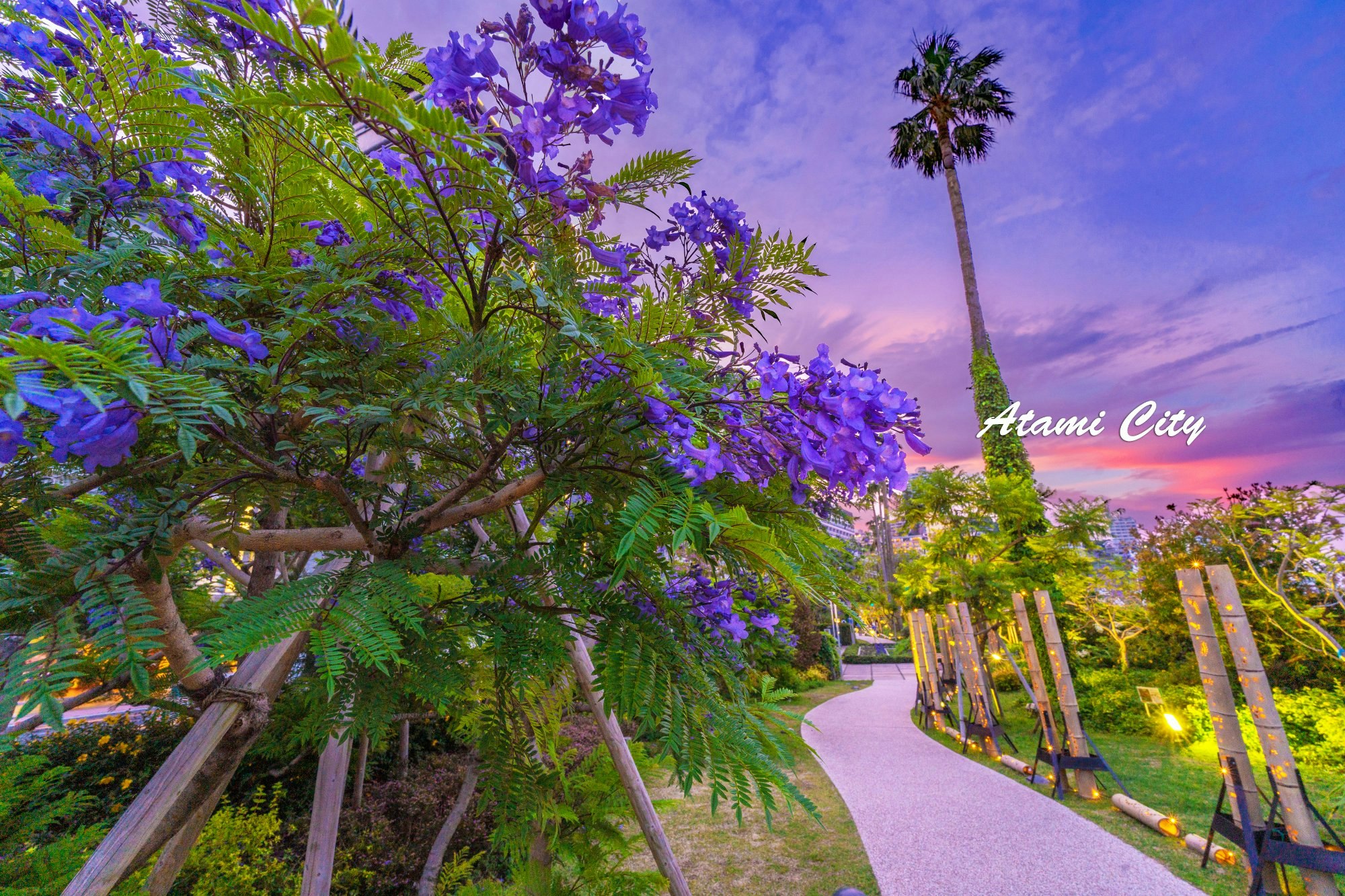
Are you familiar with jacaranda, a member of the Bignoniaceae family native to South America?
As shown in the photos, it produces clusters of purple flowers like bunches of grapes, and the contrast of green leaves and purple blooms makes it a very beautiful deciduous tall tree.
In Atami City, you can find tall trees (towering overhead) and smaller shrubs (at eye level) along Route 135 (the Jacaranda Promenade in Tokaigancho to Shinshicho “Waterside Park” along the sidewalk, and inside Waterside Park).
Although jacaranda’s flowering season in Japan is said to be June, it is extremely rare for it to bloom outdoors on the mainland because of the climate. Some years in Atami saw no flowering at all, and some trees bloom a second time in September or October rather than only in June.
Even when they do bloom, not all trees flower; some years only a few trees bloom. Some trees produce many flowers, some only a single cluster, and some not at all.
How much will bloom this season?
※Bougainvillea along the Itagawa River also reaches its best viewing at the same time, so please visit both.
Main jacaranda planting locations and numbers
● Jacaranda Promenade (along Route 135, beside the sun deck) … one tall tree about 10 m, four trees 3–5 m, and 100 shrubs 1–2 m
● Along Route 135, downbound (from the Central Police Box to Waterside Park Section 2) … 20 trees 5–6 m
● Waterside Park Section 3 … one tall tree of about 2 m near the pedestrian bridge, and five shrubs on the Wada River slope
Total above: 25 tall trees (non-shrub) and 105 shrubs
History
・In July 1990, one tree was planted in Omiya Green Space to commemorate the sister-city partnership with Cascais, Portugal
・In 2000, 24 trees were planted along the national highway (diagonally in front of the Central Police Box to in front of the Waterside Park event plaza)
(Since then, some have been transplanted and others newly planted.)
・In April 2013, trees were planted in Waterside Park Section 2 (in front of the Tourist Association) and Section 3 (three trees in Section 2 and two in Section 3)
・On June 1, 2013, the “Jacaranda Promenade” was completed in Omiya Green Space (45 young trees planted)
・From September 2013 to June 2014, Omiya Green Space (west side) was developed (planting), and a few trees were transplanted from along the national highway
・June 2014, completion of the “Jacaranda Promenade”
Address / Tokaigancho to Nagisacho, Atami City, Shizuoka Prefecture
Phone / 0557-86-6218 (Atami City Park and Greenery Division)
Access / To the Jacaranda Promenade (Omiya no Matsu)
■ About a 20-minute walk from JR atami station
■ About a 5-minute bus ride from JR atami station toward Atami Port → get off at “Omiya no Matsu”
Parking / City-operated paid parking (East parking lot, Waterside Park, etc.) and others
This text has been automatically translated.
Show original text
Show original text
Atami Tourism Association posted.
![[Image1]NishikigauraOne of Atami’s scenic spots. This celebrated coastline of sheer cliffs stretches about 1](https://img.cooljapan-videos.com/files/member_posts/image/de8fb5cd0423de35c75db5b84dfca31a977a5479.jpg)
![[Image2]NishikigauraOne of Atami’s scenic spots. This celebrated coastline of sheer cliffs stretches about 1](https://img.cooljapan-videos.com/files/member_posts/image/b5e1b9c9db59cd379318d28d528caf5ff5c4d9df.jpg)
![[Image3]NishikigauraOne of Atami’s scenic spots. This celebrated coastline of sheer cliffs stretches about 1](https://img.cooljapan-videos.com/files/member_posts/image/98c8c6ef46722d9f6b79cd1b35d37053c5b90689.jpg)
Nishikigaura
One of Atami’s scenic spots. This celebrated coastline of sheer cliffs stretches about 1 kilometer south from Uomizaki, the gateway to the Izu Peninsula. (Uomizaki–Nishikigaura–Sogaura totals about 2 kilometers)
When the sun rises, its light pours over the bay and flashes in five brilliant colors, so the place took the poetic name Nishikigaura, borrowing the image of woven brocade from Kyoto.
Remnants of the Atami-Taga volcano remain here, and legends linked to historical figures such as Minamoto no Yoritomo and Kato Kiyomasa still survive.
The cliffs tower about 80 meters high. Strange rock formations carved by the rough waves—Kabuto Rock, Bedrock, Eboshi Rock, Benten Rock—stand in a row, while Hatsushima and Oshima float offshore.
For the best view, head to the area near Hotel New Akao and the cafe “Hana no Yousei.”
Note: Access to Hotel New Akao’s rooftop garden is limited to hotel guests only. Thank you for your understanding.
Address / 〒413-0033 Atami, Atami City, Shizuoka Prefecture (near Hotel New Akao)
Access / From JR atami station take a bus bound for Ajiro for about 15 minutes and get off at Nishikigaura
Parking / None
This text has been automatically translated.
Show original text
Show original text
1 Comment(s)
Atami Tourism Association posted.
![[Image1]Former Hinata Family Atami Villa (Former Hinata Villa)Rihei Hinata, who prospered in Asian trade, co](https://img.cooljapan-videos.com/files/member_posts/image/633b1c77d42bae58b4a53c91f828a11791dbba87.jpg)
![[Image2]Former Hinata Family Atami Villa (Former Hinata Villa)Rihei Hinata, who prospered in Asian trade, co](https://img.cooljapan-videos.com/files/member_posts/image/96b8b1e1155908b4628f090513c43e71742c19f9.jpg)
![[Image3]Former Hinata Family Atami Villa (Former Hinata Villa)Rihei Hinata, who prospered in Asian trade, co](https://img.cooljapan-videos.com/files/member_posts/image/80ae7c8eed5ccb5a05ad7e74a92478fea103d1ea.jpg)
![[Image4]Former Hinata Family Atami Villa (Former Hinata Villa)Rihei Hinata, who prospered in Asian trade, co](https://img.cooljapan-videos.com/files/member_posts/image/80a12ae6192905ee355dbdd3d0a27f0c9876e0d0.jpg)
![[Image5]Former Hinata Family Atami Villa (Former Hinata Villa)Rihei Hinata, who prospered in Asian trade, co](https://img.cooljapan-videos.com/files/member_posts/image/72def665333277d60b26d7cb7dc874c5ee479ef0.jpg)
Former Hinata Family Atami Villa (Former Hinata Villa)
Rihei Hinata, who prospered in Asian trade, completed this detached villa in 1936 (Showa 11) as an annex to his main residence.
The two-story wooden main building was designed by Jin Watanabe, known for projects such as Wako in Ginza, Tokyo, the Tokyo National Museum in Ueno, and the Aichi Prefectural Office.
The basement’s interior was designed by the world-renowned German architect Bruno Taut, making this the only surviving architectural work he left in Japan.
The villa comprises three main rooms: a social room richly furnished with bamboo and paulownia wood, a Western-style room with an interior staircase as part of the room, and a Japanese-style tatami room. The design consciously reflects Japanese aesthetic traditions such as the Katsura Imperial Villa and Ise Grand Shrine.
After the death of the Hinata family head, the villa was carefully used as a corporate retreat. Faced with the threat of demolition in 2004 (Heisei 16), Atami City acquired the property thanks to a donation from a philanthropist living in Tokyo. In 2006 (Heisei 18), it was designated as an Important Cultural Property of Japan.
More than 80 years after its completion, deterioration and the urgent need to improve seismic performance made repairs critical. From fiscal 2018 (Heisei 30) to fiscal 2021 (Reiwa 3), large-scale conservation and repair work was carried out.
In August 2022, the villa reopened to the public after preserving and reproducing its original condition as much as possible.
※Visits require advance reservation only (online reservations only). For details and reservations, please check the Atami City official website.
Address/8-37 Kasuga-cho, Atami City, Shizuoka Prefecture 413-0005
Phone/0557-86-6232 (Atami City Lifelong Learning Division, Cultural Exchange Office: weekdays only)
Access/About a 10-minute walk from atami station
Opening days/Wednesdays, Saturdays, Sundays and public holidays 9:00–17:00, shift schedule ※online reservation required
Admission/Adults 1,000 yen; junior and senior high school students 700 yen
Parking/None
This text has been automatically translated.
Show original text
Show original text
2 Comment(s)
-
ID:1It feels comfortable to sit in the yard in a daze.This text has been automatically translated.
Show original text
Atami Tourism Association posted.
![[Image1]February 16The early-blooming atami sakura have finished, and the Oshima zakura are coming into full](https://img.cooljapan-videos.com/files/member_posts/image/48aab28e26acb8bc53a0dfa9c119278fc74e695e.jpg)
![[Image2]February 16The early-blooming atami sakura have finished, and the Oshima zakura are coming into full](https://img.cooljapan-videos.com/files/member_posts/image/b575de59c122fb3aaa9acc75060915edc7d14348.jpg)
February 16
The early-blooming atami sakura have finished, and the Oshima zakura are coming into full bloom!
White cherry blossoms are blooming at the seaside park beside Marine Spa Atami.
This text has been automatically translated.
Show original text
Show original text
2 Comment(s)
-
ID:1White cherry blossoms! First time to hear.This text has been automatically translated.
Show original text
Atami Tourism Association posted.
![[Image1]Ikeda Masuo and Yoko Sato Creative HouseThis house was the home and studio of the late multi-artist](https://img.cooljapan-videos.com/files/member_posts/image/32094c06f3971803db836a420ea4bcf6a0e291c7.jpg)
![[Image2]Ikeda Masuo and Yoko Sato Creative HouseThis house was the home and studio of the late multi-artist](https://img.cooljapan-videos.com/files/member_posts/image/537eed5f0a7ec9728b4283e980cd395a4aba88fb.jpg)
![[Image3]Ikeda Masuo and Yoko Sato Creative HouseThis house was the home and studio of the late multi-artist](https://img.cooljapan-videos.com/files/member_posts/image/8db06deff388e5121a2a46b185fc51bac24ee528.jpg)
![[Image4]Ikeda Masuo and Yoko Sato Creative HouseThis house was the home and studio of the late multi-artist](https://img.cooljapan-videos.com/files/member_posts/image/f1323e427af2b2e47cd35b58a9178956b0d76853.jpg)
Ikeda Masuo and Yoko Sato Creative House
This house was the home and studio of the late multi-artist Ikeda Masuo, who excelled in printmaking, painting, and film. He lived here from 1982 (Showa 57) until his death in 1997 (Heisei 9), sharing the space with world-renowned violinist Yoko Sato.
The house, where the two prodigies lived together and based their artistic activities, exhibits Ikeda’s handwritten manuscript of his Akutagawa Prize-winning work "Dedicated to the Aegean Sea," his chronology, photographs, lithographs, and ceramic panels, as well as Sato’s stage dresses, musical scores, chronology, and photographs.
Come see a glimpse of their glamorous yet unpretentious daily life.
Address / 10-24 Kaikocho, Atami City, Shizuoka Prefecture, 413-0003
Phone / 0557-81-3258 (Creative House)
Access / About a 15-minute walk from atami station / About a 3-minute bus ride from atami station toward Izusan Shrine, get off at Momoyama, then about a 3-minute walk
Opening hours / 9:00–16:30 (last admission by 16:00)
Closed / Every Tuesday (open on public holidays) and during the New Year holidays
Admission / Adults 360 yen, junior and senior high school students 240 yen, elementary school students and younger free
*Children below elementary school age are not allowed to enter unaccompanied
Parking / None
This text has been automatically translated.
Show original text
Show original text
Atami Tourism Association posted.
![[Image1]Atami Nanayu (The Seven Hot Springs of Atami)As you walk through the town, you can spot steam rising](https://img.cooljapan-videos.com/files/member_posts/image/521fb8920bfbcbe0af1e8a0aaed0f7e006751218.jpg)
![[Image2]Atami Nanayu (The Seven Hot Springs of Atami)As you walk through the town, you can spot steam rising](https://img.cooljapan-videos.com/files/member_posts/image/f30f870354fb58a359d4b46f54584f12caffc9ed.jpg)
![[Image3]Atami Nanayu (The Seven Hot Springs of Atami)As you walk through the town, you can spot steam rising](https://img.cooljapan-videos.com/files/member_posts/image/c7d04cb59cfe86469766f488a3f1508f313d15cc.jpg)
![[Image4]Atami Nanayu (The Seven Hot Springs of Atami)As you walk through the town, you can spot steam rising](https://img.cooljapan-videos.com/files/member_posts/image/ad69e0105f4c8ded39539b50cb9bac07f1fe9122.jpg)
![[Image5]Atami Nanayu (The Seven Hot Springs of Atami)As you walk through the town, you can spot steam rising](https://img.cooljapan-videos.com/files/member_posts/image/1e2d693b97c686132e9ffd2196dacdb7fdc3e528.jpg)
![[Image6]Atami Nanayu (The Seven Hot Springs of Atami)As you walk through the town, you can spot steam rising](https://img.cooljapan-videos.com/files/member_posts/image/9c20b185946a004a622e942aeef81e33f5b9d371.jpg)
![[Image7]Atami Nanayu (The Seven Hot Springs of Atami)As you walk through the town, you can spot steam rising](https://img.cooljapan-videos.com/files/member_posts/image/7a98968ab57f6e27842d633e56200e8f01c7bb9d.jpg)
Atami Nanayu (The Seven Hot Springs of Atami)
As you walk through the town, you can spot steam rising from various slopes.
These are the source springs known as the “Atami Seven Hot Springs.”
You can tour the springs and experience their long history and hot-spring atmosphere.
(Each of the seven guideboards has a commemorative stamp.)
• The Oyu Geyser was a naturally erupting spring famous worldwide as an old intermittent spring.
Oyu erupted six times day and night, blasting water and steam in alternating, violent bursts that were said to make the ground tremble.
Its activity gradually declined from the middle of the Meiji era and ceased in 1923 (Taisho 12) though it did erupt again during a major earthquake. In 1962 (Showa 37) it was preserved as a city cultural property and remains so today.
※Today, water is artificially ejected roughly every five minutes to recreate the historic eruptions of Oyu.
Address / 〒413-0018 Kamiyadocho, Atami City, Shizuoka Prefecture
Phone / 0577-86-6232 (Atami City Lifelong Learning Division, Cultural Facilities Office)
Access / About a 20-minute walk from JR atami station / About 20 minutes from JR atami station by Yu-Yu Bus → get off at Oyu Geyser → about a 3-minute walk
Parking / None
• Ozawa no Yu
The baths in the gardens of Sawaguchi Yazaemon, Fujii Bunjiro, and Yonekura Sazaemon were once called Heizaemon no Yu, but locals called them Ozawa no Yu because they were in a small ravine.
Like Seizaemon no Yu, it is said that calling out loudly caused a strong flow, while calling softly produced a weaker flow.
At Ozawa no Yu you can cook hot-spring eggs with the steam that wells up. Locals vouch for how tasty they are, making this a small but beloved Atami attraction.
※Renovation completed on July 1, 2023. Two steaming vats were added and new benches installed.
Address / 〒413-0013 Ginza-cho, Atami City, Shizuoka Prefecture (in front of Tenjin Liquor Store)
Phone / 0557-86-6218 (Atami City Parks and Greenery Division)
Access / About a 15-minute walk from JR atami station
Parking / A few paid parking spaces are available nearby
In addition to these two sites, there are Furo no Yu and Mizu no Yu, Sajiro no Yu (Eye Bath), Seizaemon no Yu, Nonaka no Yu, and Kawarayu.
※The Atami Seven Hot Springs are not bathing facilities.
This text has been automatically translated.
Show original text
Show original text
4 Comment(s)
-
ID:2Hot springs all over Japan are quite distinctive, so it's no wonder that Taiwanese love to go to Japan to soak in hot springs.This text has been automatically translated.
Show original text -
ID:1There are also hot springs in the city like thisThis text has been automatically translated.
Show original text