Check out these articles
-
 Video article 15:24
Spring Is a Wonderful Time of Year When the Whole of Kyoto Is Bathed in the Brilliant Colors of Cherry Blossoms! Explore Some of Kyoto’s Most Popular Cherry Blossom Viewing Locations!
Travel- 131 plays
- YouTube
-
Video article 3:50
This Endless Pink Cherry Blossom Tunnel Will Leave You Breathless! Introducing Attractions and Useful Information About the Popular Tourist Spot "Nicchu Line Weeping Cherry Blossom Path" in Kitakata, Fukushima Prefecture!
Travel- 880 plays
- YouTube
-
Video article 3:32
Osaka Mint's "Cherry Blossom Passage" is a springtime tradition in Osaka. Cherry blossoms at the Mint Bureau! Introducing the best time to see and highlights of the cherry blossoms.
NatureTravel- 107 plays
- YouTube
-
Video article 1:01
The Cherry Blossom Blizzard at Ueno Park - One of the Most Famous Hanami Spots in Tokyo! The Ueno Cherry Blossom Festival in Taito City Boasts Approximately 1,200 Cherry Trees in Full Bloom!
TravelFestivals & Events- 534 plays
- YouTube
-
Video article 1:40
Enjoy the Cherry Blossoms at Goryokaku, a Popular Sightseeing Spot in Hakodate, Hokkaido! The Cherry Blossoms at This Historical Spot Are Exceptionally Beautiful!
Travel- 49 plays
- YouTube
-
Video article 1:56
Spring Quartet: Enjoy Cherry Blossoms Along the Funakawa River in Toyama! Beautiful Views That Only a Drone Could Capture!
TravelNature- 162 plays
- YouTube
-
Video article 2:38
Gorgeous Scenery and Only 30 Minutes Away From the Center of Tokyo! Beautiful, Fluttering Cherry Blossoms, and Colorful Tulips in Tachikawa's Showa Kinen Park!
Travel- 314 plays
- YouTube
-
Video article 5:10
The contrast between cherry blossoms and rape blossoms at Gongendo Tsutsumi in Satte City, Saitama Prefecture was too beautiful! The pink tunnel of 1 kilometer-long senbonzakura cherry blossoms is a spectacular sight!
Travel- 503 plays
- YouTube
-
Video article 5:14
Mt. Yoshino in Nara Prefecture – Experience a Panoramic View of 30,000 Beautiful Cherry Blossoms at One of the Most Famous Cherry Blossom Viewing Locations in Japan
TravelNature- 360 plays
- YouTube
What Are Kakunodate Bukeyashiki Street and Hinokinai River Cherry Blossom Promenade? 2026 Kakunodate Cherry Blossom Festival: Dates, Best Time to Visit & Access Guide
Why Is Tohoku's Akita Considered One of the World's Greatest Cherry Blossom Destinations?
This video, titled "KAKUNODATE|A Famous Cherry Blossom Spot in Tohoku|Bukeyashiki Street and Hinokinai River Bank, Akita|4K UHD Cherry Blossoms, Akita Tohoku Japan" (KAKUNODATE 東北の桜名所 秋田・角館武家屋敷通りと桧木内川堤の桜並木 4K UHD Cherry Blossoms, Akita Tohoku Japan), was uploaded by "Japan Videography."
Cherry blossoms are now a popular flower all over the world, but many of them were selectively bred in Japan and have been designated as protected species.
The Yoshino Cherry, which came to be in the Edo period (1603 to 1868), is exported the most around the world and many people enjoy viewing it during the blooming season because of its beauty.
Japan is said to be a mecca for cherry blossom fans around the world, which means that Japan's cherry blossom viewing spots are some of the best in the world.
This is a 4K video showcasing the breathtaking weeping cherry trees along Kakunodate's Bukeyashiki (武家屋敷, Samurai Residence) Street — said to be the most beautiful row of weeping cherries in Japan — as well as the Yoshino Cherries along the Hinokinai River in Akita Prefecture.
Enjoy the beautiful footage of the entire area dyed in shades of pink.
What Is the History Behind Kakunodate's Bukeyashiki Street?
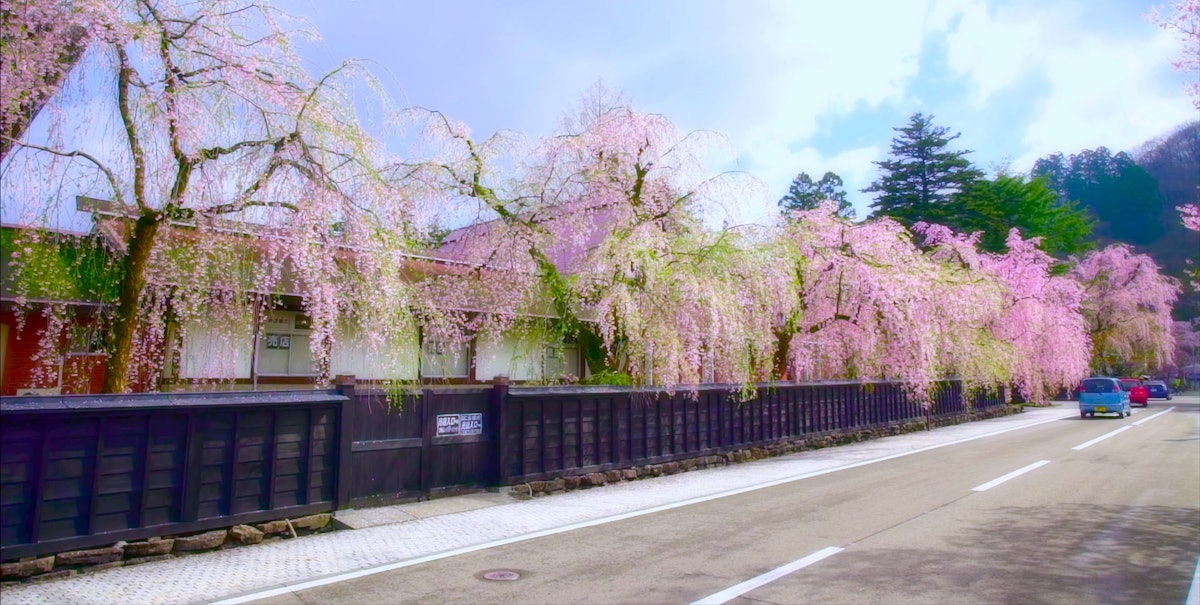
As you can see from 0:39 in the video, Bukeyashiki Street in Kakunodate is a sightseeing destination in Semboku, Akita.
Within a roughly 2 km radius, samurai residences from the Edo period stand side by side, and each spring, magnificent weeping cherry trees burst into bloom against the stylish black-boarded fences, filling Bukeyashiki Street with color.
Bukeyashiki Street in Kakunodate is known as "the Little Kyoto of Michinoku" and has been designated a National Important Preservation District for Groups of Historic Buildings. Every year during the cherry blossom season, visitors from both Japan and abroad flock here to admire the gorgeous contrast between the delicate weeping cherries and the stately samurai residences.
Kakunodate is a historical castle town that has thrived since the Edo period.
Akita was ruled by the Satake clan, and the Kakunodate of today was once the domain of Satake Yoshichika, the first deputy of the Satake Kita family of Kakunodate, whose birthplace still retains its former appearance today.
The history of Kakunodate as a cherry blossom destination traces back approximately 400 years, when the wife of Yoshiaki, the second-generation head of the Satake Kita family, is said to have brought three weeping cherry sapling from Kyoto upon her arrival as a bride and planted them in the residence garden.
Those three trees became the origin of what is now a magnificent promenade of approximately 400 cherry trees stretching from Bukeyashiki Street all the way to the banks of the Hinokinai River. Of these, 162 weeping cherry trees have been designated as National Natural Monuments, and the area has also been selected as one of Japan's Top 100 Cherry Blossom Sites.
You can see the weeping cherries filling Bukeyashiki Street from 1:26 in the video.
What Makes the Yoshino Cherries Along Hinokinai Riverbank So Special?
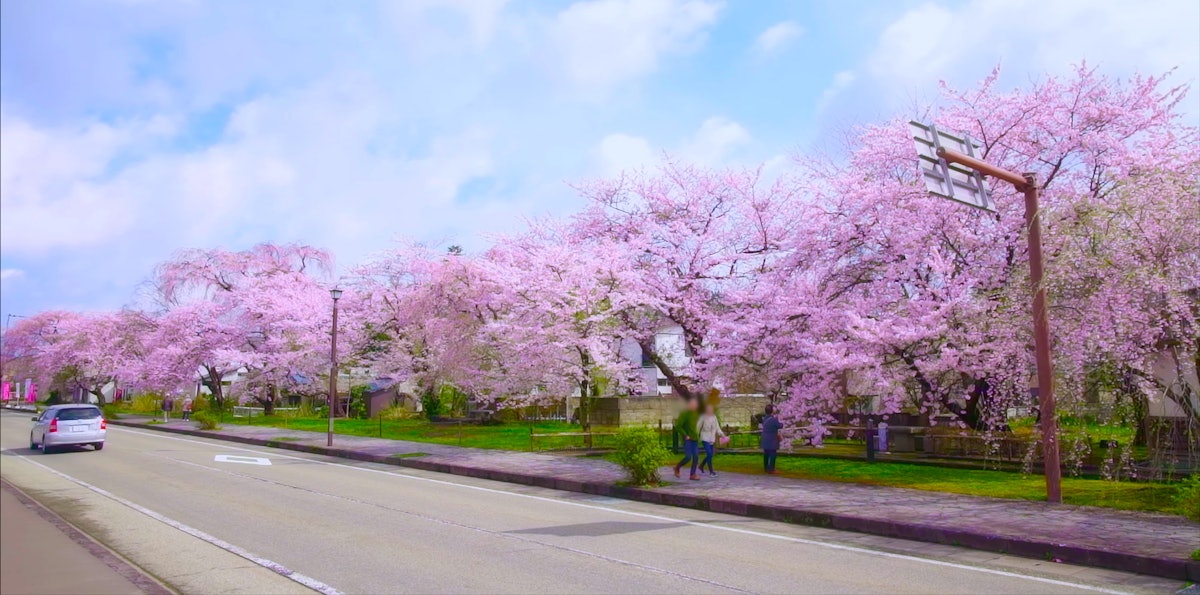
The Hinokinai Riverbank, shown from 3:04 in the video, is a bank built along the Hinokinai River that runs behind Bukeyashiki Street.
Unlike the weeping cherries on Bukeyashiki Street, the trees planted here are Yoshino Cherries (Somei Yoshino).
The Yoshino Cherries along the Hinokinai Riverbank were first planted in 1934 to commemorate the birth of the 125th Emperor of Japan — known today as the Emperor Emeritus (上皇陛下). Designated as a National Site of Scenic Beauty and one of Japan's Top 100 Cherry Blossom Sites, the promenade stretches for approximately 2 km in a breathtaking tunnel of blossoms. Another highlight unique to this spot is the view of the Akita Shinkansen "Komachi" passing alongside the cherry-lined riverbank — a scene that has become a beloved photo opportunity for visitors.
The 2026 cherry blossom season is the perfect time to visit this historically significant promenade and experience its timeless beauty for yourself.
When Is the 2026 Kakunodate Cherry Blossom Festival and What Is the Best Time to Visit?
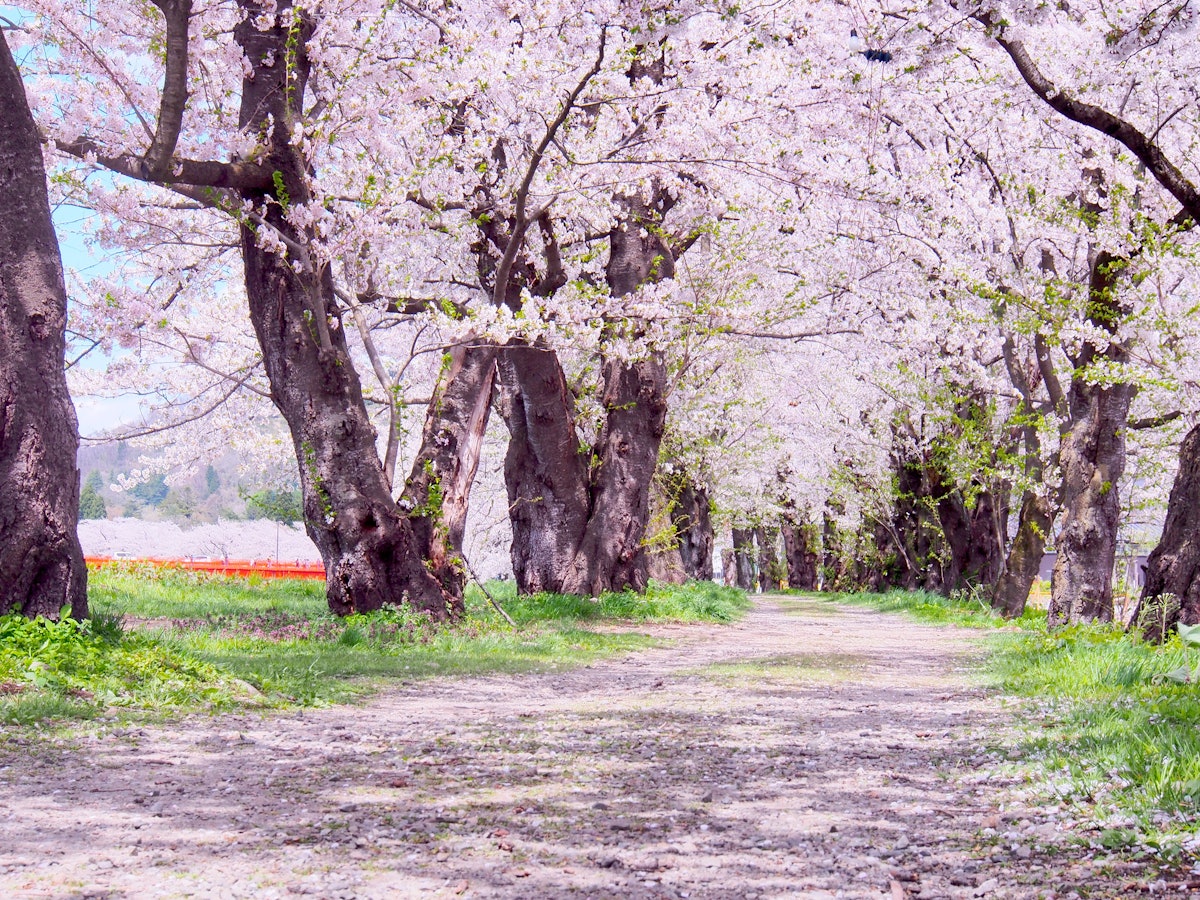
Both Kakunodate's Bukeyashiki Street and the Yoshino Cherries along Hinokinai Riverbank are typically at their best from mid-April to early May.
During peak bloom, the "Kakunodate Cherry Blossom Festival" is held, offering daytime hanami (flower viewing), spectacular illuminated night cherry blossom viewing, food stalls, and live stage performances — drawing crowds of visitors from across the country and beyond. In 2026, the festival is scheduled to run from Wednesday, April 15 to Tuesday, May 5 (a national holiday), with the possibility of a pre-opening event depending on blooming conditions.
If you are visiting during this season, be sure to enjoy local gourmet experiences such as sweetfish fishing, an oyakodon rice bowl made with Akita's prized Hinai Jidori chicken, silky Inaniwa Udon noodles, and exquisitely crafted Japanese sweets. A visit to the Kakunodate Birch Textile Museum is also highly recommended.
There are also shops nearby that offer full kimono rental sets, so strolling through the cherry blossom promenade by rickshaw in traditional Japanese dress is a wonderfully elegant way to take in the scenery.
How Do You Get to Kakunodate's Bukeyashiki Street and Hinokinai River Cherry Blossom Promenade?

The cherry blossom promenades along Bukeyashiki Street in Kakunodate and the Hinokinai Riverbank in Akita have been designated a National Site of Scenic Beauty.
As Akita is located in the northern part of Honshu, cherry blossoms bloom later here than in the Kanto region — with mid-April onward serving as a general guide for the 2026 bloom season.
A live camera is set up on Bukeyashiki Street, allowing you to check the current blooming status online before your visit.
Bukeyashiki Street is approximately a 20-minute walk from JR Kakunodate Station. By car, it is about 40 minutes from the Omagari IC on the Akita Expressway, or approximately 80 minutes from the Morioka IC on the Tohoku Expressway. Note that Bukeyashiki Street is closed to vehicles during the festival period, and surrounding roads can become heavily congested, so the use of public transportation is strongly recommended. Paid parking is available nearby (approximately 400 spaces, ¥500 per day for standard vehicles), with free temporary parking lots also provided during the festival.
Please check the official website for the latest information on nearby attractions and traffic regulations.
【Official Website】Live Camera
https://www.city.semboku.akita.jp/en/
【Tripadvisor】Hinokinai River
https://www.tripadvisor.com/Attraction_Review-g1022324-d15296391-Reviews-Hinokinai_Kawa_Tustusmi-Semboku_Akita_Prefecture_Tohoku.html
-
Video article 3:07
Daishoin – An Ancient Buddhist Temple on Miyajima
Travel Art & Architecture- 776 plays
- YouTube
-
Video article 4:24
Zao Ropeway Autumn Leaves in Yamagata, 800m Shifts the Peak
Travel Nature Local PR- 77 plays
- YouTube
-
Video article 4:03
The Video That's Making Headlines Around the World! This Video Introduction to Japan, Which Captures the Eyes of Viewers Moment by Moment, Is Both High Quality and Inspiring!
Travel Things to Do Modern Culture- 8.94K plays
- YouTube
-
Video article 2:37
Okunoshima AKA "Rabbit Island," Is a Paradise for Rabbits in Hiroshima Prefecture! Soothe Your Spirit With the More Than 900 Rabbits That Inhabit the Island!
Travel Living Things- 806 plays
- YouTube
-
Video article 6:19
What Are Kakunodate Bukeyashiki Street and Hinokinai River Cherry Blossom Promenade? 2026 Kakunodate Cherry Blossom Festival: Dates, Best Time to Visit & Access Guide
Travel- 931 plays
- YouTube
-
Video article 9:06
An exciting experience of crossing the thrilling Kadowaki Suspension Bridge over a precipitous cliff! Enthralled by the beautiful natural scenery of the Izu area in Ito City, Shizuoka Prefecture!
Travel Nature- 294 plays
- YouTube
-
Video article 3:01
In the Hokkaido city of Nayoro, the Nayoro Sunflower Festival is a summer tradition! Enjoy the beauty of fields of sunflowers that stretch as far as the eye can see!
Travel Nature Local PR- 585 plays
- YouTube
-
Video article 5:06
The Kachi Daruma Dolls of Katsuoji Temple! Discover the Popular Dolls at the Temple in Minoh, Osaka!
Travel Art & Architecture- 461 plays
- YouTube
-
Video article 7:41
Isonokami Shrine – The Oldest Shrine in Japan. Discover Sacred Swords, and Ancient Amulets at This Shrine Surrounded by a Divine Forest in Kanagawa Prefecture
Travel History- 234 plays
- YouTube
-
Video article 4:46
A Look at the Cute Eurasian Red Squirrel of Hokkaido! These Critters Are Something Out of a Fairy Tale!
Travel Nature Living Things- 604 plays
- YouTube
-
Video article 2:07
Things to Do in Ogimi, One of the Three Yanbaru Villages in Okinawa Prefecture! Experience Nature, Food, History, and Culture in the Village With the Longest Life Expectancy in Japan!
Travel Nature Things to Do- 434 plays
- YouTube
-
Video article 4:06
Japan's Top 3 Nighttime Cherry Blossom Spots 2026: Latest Info & Best Viewing Times at Ueno Park, Hirosaki Park & Takada Park
Travel Festivals & Events Nature- 593 plays
- YouTube



Comment