-
Article
-
Channel
-
Region
-
Season
-
Tag
Articles
-
 Video article 2:10
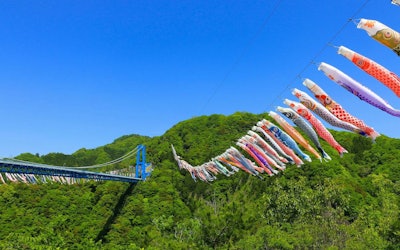
The spectacular sight of 1,000 carp streamers swimming in the river is breathtaking! Also introduces the highlights of the Ryujin Gorge!
Festivals & Events Travel Nature- 115 plays
- YouTube
The Ryujin Gorge Koinobori Festival: Video Introduction This video, titled "The Ryujin Gorge Koinobori Festival" (竜神峡鯉のぼりまつり), was uploaded by "Suzuki Hideto." Ryujin Gorge is a beautiful V-shaped gorge located in Hitachiota, Ibaraki, in Japan's Kanto region. The gorge is even more crowded during the Golden Week holiday season, when it's dazzling with fresh greenery. Around 1,000 koinobori (carp streamers) can be seen swimming through the sky around the Ryujin Gorge, with the Ryujin Suspension Bridge at the heart of the action. This spectacular sight has become popular among many tourists for its picturesque views. The video shows the spectacular sight of the Ryujin Gorge and koinobori swimming in the sky via aerial views, so be sure to check it out as you read along. Where Ryujin Suspension Bridge Is Located + Height & Other Information About the Bridge Photo:Mori no Kane, Ryujin Suspension Bridge Ryujin Gorge is located in Okukuji Prefectural Nature Park in Hitachiota, Ibaraki. Ryujin Suspension Bridge was built over the Ryujin Dam, which was constructed to dam the Ryujin River that flows through Ryujin Gorge. The bridge is 375 meters long, making it one of the longest pedestrian-only bridges in Japan. Visitors can also enjoy the thrilling view from the observation windows installed at three locations on the bridge, which are up to 100 meters high. On the other side of the Ryujin Suspension Bridge is the symbolic "Mori no Kane" (木精の鐘, lit. 'Bell of the Tree Spirits') with three types of bells: love, hope, and happiness. The bell of love is especially popular among couples, as it requires two people to press a button together. If they ring the bell together, it's said that their wishes may come true. The main attraction of the Ryujin Suspension Bridge is the breathtaking natural scenery of the mountains and valleys. The beautiful sound of the bells echoing through Ryujin Gorge is one of the highlights of the bridge. The History of the Ryujin Gorge Koinobori Festival Photo:Koinobori at Ryujin Suspension Bridge, Hitachiota, Ibaraki The Ryujin Gorge is especially busy during the "Ryujin Gorge Koinobori Festival" held from late April to mid-May. Approximately 1,000 koinobori are on display around the Ryujin Suspension Bridge, and visitors can see them swimming through the sky over the entire Ryujin Gorge area. The Ryujin Gorge Koinobori Festival began in 1989. When the construction of the Ryujin Suspension Bridge began, wire ropes were stretched over the right and left banks of the Ryujin Dam, and koinobori were attached to them. Today, it has become a major event that attracts more than 30,000 tourists, and the parking lot with 265 parking spaces is packed even before 8:30 am. Although it's convenient to come by car, it may be better to use public transportation, such as buses or trains. Due to the spread of the new coronavirus infection, the festival was cancelled for two consecutive years, but in 2022, it was held from April 29 to May 15, followed by 2023, from April 29 to May 14. The festival is usually held during Golden Week each year. For more information on the 2024 Ryujin Gorge Koinobori Festival, please check the official website or the official Instagram of the Ryujin Suspension Bridge. During the festival, a photo contest will be held in addition to a market of wild vegetables and other products. In addition, on Children's Day, children of junior high school age and under will be admitted free of charge, whereas normally there is a crossing fee of 320 yen for adults and 210 yen for children. In addition to the "Carp Streamer Festival," Ryujin Gorge holds seasonal events such as the "Wind Bell Festival" from early to mid-August, where 1,000 wind bells are displayed; the "Autumn Leaves Festival" from early to late November, which includes a stamp rally and a product exhibition to enjoy autumn tastes; and the "Hitachi-Ota Soba Festival" in February, where visitors can enjoy Hitachi-Aki soba noodles. In February, the "Hitachiota Soba Festival" is held, where visitors can enjoy Hitachiota's autumn soba noodles. Bungee Jumping, Canoeing, & Other Exciting Outdoor Activities at Ryujin Gorge! Photo:Bungee jumping at Ryujin Gorge Ryujin Gorge, widely known for its koinobori festival, is also a popular place for outdoor recreation. The bungee jump from the Ryujin Suspension Bridge is known as the highest bungee jump in Japan. There are only a few bungees in the world that can be jumped from a height of 100 meters, and more than 10,000 jumpers visit the bridge every year to experience the thrill of the jump. Canoeing tours are a great way to enjoy the beauty of nature reflected on the nearby lake while looking up at the Ryujin Suspension Bridge. There are lectures in advance so that canoe and kayak beginners and families can also enjoy the tour and experience the beautiful nature of the Ryujin Gorge while canoeing. The Ryujin Café, located right next to the reception desk of the Ryujin Suspension Bridge, is a recommended spot for grabbing a bite to eat. On the terrace seats, you can enjoy a "Natto Waffle" and "Ryujin Dam Curry" while appreciating the great nature of the Ryujin Gorge and the Ryujin Suspension Bridge. Consider stopping here for lunch or just to take a break. Enjoy a Sea of Clouds Over Ryujin Gorge at the Akaiwa Observatory or Discover the Scenic Views of the Area While Hiking! Photo:Autumn leaves at Ryujin Gorge, Hitachiota, Ibaraki In the early morning on a cold day, a sea of clouds can be seen from the Ryujin Suspension Bridge over Lake Ryujin, a dammed lake in the Ryujin Gorge. From the Akaiwa Observatory, you can see the entire Ryujin Gorge area, including the Ryujin Suspension Bridge. The Akaiwa Observatory is located on top of a mountain roughly 1 km away from the second parking lot of Ryujin Gorge. The scenic views from the observatory are unforgettable. During autumn, you can see the Ryujin Gorge and the Ryujin Suspension Bridge floating in a sea of clouds with the mountains dyed beautiful shades of orange and red in the background. The photogenic views are sure to look good on Instagram, so be sure to bring a camera. There's also an entrance to a hiking course from Parking Lot 2, so keep this in mind if you're looking to take a walk to feel the great outdoors in spring or autumn. What are Koinobori? Koinobori (鯉のぼり), meaning "carp streamer," are carp-shaped windsocks that date back to Edo-Period Japan (1603 AD -1868 AD). In modern Japan, they are flown to celebrate Children's Day, a holiday during Japan's Golden Week that celebrates the healthy growth of children. The reason for the carp is due to an ancient Chinese legend that tells of a carp that climbed the rapids of the Yellow River and became a dragon. This is said to symbolize the growth of children. Koinobori are generally painted in three colors: Black Black represents water, something that all living things need. Blue Blue represents spring, the season of life, and wood. Red Red represents summer and fire. Summer is the season with the most sunlight, and this symbolizes the nurturing of life. Two other common colors are yellow and white. All of these colors also represent the five elements in Japanese Buddhist thought. Additionally, koinobori are hung above houses in Japan with children, with black at the top, symbolizing the father, followed by red, symbolizing the mother, and then blue, etc., which symbolize the children. Summary of the Ryujin Gorge The 1,000 koinobori swimming in the sky of Ryujin Gorge is a spectacular sight. Watching the video, it's easy to understand why so many tourists come to the area for the koinobori festival. In addition, the Ryujin Gorge can be enjoyed in a variety of ways, including outdoor recreation and hiking. Near the Ryujin Suspension Bridge is Fukuroda Onsen Omoide Roman-kan, a hot spring inn. Staying at a hotel or ryokan and relaxing at the hot springs is another great way to have an enjoyable trip. The Koinobori Festival is held at the spectacular Ryujin Gorge. We encourage you to visit with your family during Japan's Golden Week holiday and make some unforgettable memories! 【Trip Advisor】Ryujin Gorge -
 Video article 2:51
The Seihakusai Festival of Nanao, Ishikawa! See the Large Floats and the Unique Street Parades in 4K Video!
Festivals & Events Traditional Culture Travel- 141 plays
- YouTube
The Giant Floats of the Seihakusai Festival of Nanao, Ishikawa: Video Introduction This video, titled "Seihakusai Festival – Dekayama Floats Parading Through Town|2017 in 4K" (青柏祭 でか山が街を行く 2017 in 4K), was uploaded by "officeliquid." It's a powerful 4K video of the Seihakusai Festival of Nanao, Ishikawa, in Japan's Koshin'etsu Region. At the Seihakusai Festival, recognized as a UNESCO Intangible Cultural Heritage, the largest floats in Japan, referred to as "Dekayama," are pulled through the streets of the city. The sight of the Dekayama going from one alley to the next is an incredible sight. The shouting of the crowds and the gentle May breeze make it feel like the festival is taking place right before your eyes, something that can only be achieved with such high-definition video. Enjoy the 3-minute movie showing what it's like to travel to Noto during summer! About Ishikawa Prefecture Ishikawa Prefecture is located approximately 2.5 hours northwest of Tokyo via bullet train. It's bordered by Toyama, Fukui, and Gifu Prefectures, as well as the sea. Bordering the sea, Ishikawa is known for its delicious seafood, and is also home to a number of popular tourist attractions, including Kenrokuen Garden, one of the "Three Most Beautiful Gardens in Japan," and Kanazawa Castle, both of which are located in Kanazawa, the capital of Ishikawa. In addition, it's home to unique cultures and traditional crafts, such as Kanazawa Lacquerware, and Kanazawa Gold Leaf. An Introduction to Festivals in Japan Japan is home to thousands of festivals each year. The Japanese word for festival is "matsuri" (祭り), which comes from the word "matsuru" (祭る, to deify, to enshrine). The reason Japan has so many festivals has to do with Japanese culture and religion. Japan is said to be home to 8 million gods, and practically every area in Japan has a shrine that worships a particular god. Because of this, many shrines also have their own annual festivals, with different meanings and origins. There are seasonal festivals to pray for good harvests, bon festivals to pray for the souls of the dead, and even dance festivals showcasing traditional dances of a particular regions. There is a seemingly endless list of festivals, many of which are held near shrines or temples, and which often have food stalls, music, etc., for the enjoyment of participants. Some of the most famous festivals in Japan are the Gion Festival of Kyoto, the Tanabata Festival of Sendai, and the Nebuta Festival of Aomori which features large, intricate floats. Summer is particularly known to have a lot of festivals, thanks to the warm weather, so be sure to keep an eye out for them if you're visiting Japan during this time of year! What Is the Seihakusai Festival? Unraveling the History and Origins of the UNESCO Intangible Cultural Heritage! Photo:The Seihakusai Festival, Nanao, Ishikawa The Seihakusai Festival is said to have been started as a national festival by Minamoto no Shitago in the Heian period (794-1185). Yoshimune, the third lord of the Noto Hatakeyama Clan, dedicated a float to the Seihakusai Festival, following the example of the yamaboko floats of Kyoto's Gion Festival, in an attempt to incorporate Kyoto culture into the festival, and this was the beginning of the Dekayama. The Seihakusai Festival got its name from the fact that the food offered to the gods (shinsen) was served on the young leaves of an oak tree which are called "seihaku" (青柏) in Japanese. It's said that when people went to Noto, they paid a visit to Otokonushi Shrine and offered seihaku to the gods. The Seihaku Festival is an annual spring festival held at Otokonushi Shrine. [Video] 0:22 - The Large Dekayama Floats of the Seihakusai Festival The Seihakusai Festival has a history of more than 1,000 years. In 1983, the Seihakusai Festival and its large floats were designated as Important Intangible Folk Cultural Properties of Japan, and in 2016, the events with the floats were registered as UNESCO Intangible Cultural Heritages as well. The Dekayama Floats of the Seihakusai Festival + The Dolls That Adorn Them "Dekayama" is the common name for the largest floats in Japan. The huge floats are 12 meters tall, weigh 12 tons, and have wheels which are 2 meters in diameter. They're pulled by people and are a powerful sight. However, the magnificence of Dekayama is not limited to their size. The stages and dolls depicting famous Kabuki scenes which decorate the front of the Dekayama are also a highlight of the festival. The stage is also decorated with a single young pine tree, which is used to pray for the gods' descent and for the eradication of disease and a prosperous life. The puppets/dolls displayed on the Dekayama's stages are called "Ningyomi" (人形見) and are unveiled at a designated "Ningyoyado" (doll inn) in each town on the evening of May 2, where they can be viewed by the general public. The Nigyomi dolls are a rare opportunity to see the Dekayama floats from up close. After the one-night exhibition, the newly created dolls go up on the Dekayama stages each year. The Dekayama are the stars of the show, giving a large-scale performance that allows visitors to experience the history and culture of the Noto Region. Tsujimawashi and Fireworks at the Seihakusai Festival Source :YouTube screenshot The highlight of the Seihakusai Festival is the turning of the floats, which is called "tsujimawashi." To turn the floats, a special lever called an "Oteko," is wedged beneath the wheel to change the direction of the float. Seeing the tsujimawashi performed on the narrow streets of the city with an 8-meter-long lever is quite the show. Young men climb on top of the Oteko and use leverage to lift the front wheel and turn the floats. The scene of the dangerous rotation of the floats is a spectacular sight to behold. [Video] 2:35 - Young Men Riding on the Oteko as the Float Is Turned The powerful Tsujimawashi can be seen from the night of May 3 to the night of May 5 at various locations in the city center. Another highlight of the Seihakusai Festival is the fireworks. The first shot at around 8:30 pm on May 3 is for Kajicho, the first town to pull out its floats. The second shot goes off at 1:00 am on May 4, signaling Fuchu to pull out its floats, and the last shot goes off at 8:00 am on May 4 for Uomachi. Unlike the other two towns, only Uomachi has two fireworks signals, one at 7:00 am and the other at 8:00 am. The time of the fireworks may change, and fireworks may not be displayed on rainy or cloudy days. Please check weather information, etc. in advance on the official websites. When will the 2024 Aokashi Festival be held? Where will it be held? The Aokashiwa Festival, held at the Daichishu Shrine in the center of downtown Nanao, is usually held from May 3 to 5. However, from 2020, due to the spread of the new coronavirus, only the Shinto ritual was held. After the end of the outbreak, in 2023, the Dekayama Matsuri was resumed for the first time in four years, and the festival was very lively. However, the Aokashiwa Festival in 2024 was cancelled due to the Noto Peninsula earthquake. We hope that the local people will return to their daily lives as soon as possible and that the Aokashiwa Festival will resume after reconstruction. The surrounding area will be very crowded during the festival. Traffic regulations will be enforced, so we recommend that you look up information in advance, including information on temporary parking lots, if you plan to visit the area by car. How to Participate in the Seihakusai Festival Source :YouTube screenshot In previous years, the Seihakusai Festival was open to public participation in the form of pullers. Unfortunately, this was not possible in 2022 in order to prevent the spread of COVID-19. Recently, with the national policy of wearing masks after March 13th being left to the discretion of individuals, it's possible that the event will be open for public participation once again. It's best to wait for an official announcement regarding whether pullers can participate in the event. During the Seihakusai Festival, many sightseeing events will be held in the region, so be sure to check them out as well. 3 Popular Japanese Festivals Celebrated in May Here are 3 more festivals that you could consider checking out if you're visiting Japan during May: Aoi Matsuri, Kyoto Aoi Matsuri is festival with origins dating back 1,500 years. The festival features a large procession of 600 people wearing traditional clothing of Heian Period court nobles. The procession, the main event of the festival, takes place on May 15. Sanja Matsuri, Tokyo Sanja Matsuri is a festival held on the 3rd Friday, Saturday, and Sunday in May. It's one of the most famous festivals in Japan and attracts nearly 2 million spectators each year. The festival is held at the popular Sensoji Temple in Asakusam Tokyo and consists of musical floats, geiko (apprentice geisha), dancers, etc. Kanda Matsuri, Tokyo Kanda Matsuri is held at Kanda Shrine in Chiyoda, Tokyo. It is one of the 3 major festivals of Tokyo. The festival's main event is a procession of around 500 people dressed in Heian Period attire that passes through Akihabara, the electronics capital of Japan. Summary of the Seihakusai Festival of Nanao, Ishikawa The Seihakusai Festival is a spring festival that is regarded as one of the most representative festivals of the Noto Peninsula. The tradition of Hikiyama, which has been passed on since ancient times, is filled with the wishes of many people. Before the Dekayama parade, the biggest highlight of the festival, be sure to visit the Ningyoyado, where you can see the elaborate dolls and decorations up close every year. It's an awesome part of the Seihakusai Festival! Nanao, Ishikawa is one of the most accessible tourist destinations, being only about an hour away from Kanazawa, which has many tourist attractions, by train or car. We recommend visiting here for a relaxing trip to enjoy traditional events, the delicious cuisine of the Noto Peninsula, and a variety of tourist attractions! -
Video article 6:09
Video highlights of Nishi Honganji Temple in Kyoto City, Kyoto Prefecture, Japan! Don't miss the majestic architecture and gardens, registered as a World Heritage Site and a National Treasure! A popular sightseeing spot in Kyoto you can't miss!
Art & Architecture- 426 plays
- YouTube
Nishi Honganji Temple” in Kyoto City, Kyoto Prefecture, Japan Video Introduction This video, titled "Kyoto, Japan, Nishi Honganji Temple, Jodo Shinshu, Otani Honbyo, World Heritage Site, 2018/8" (京都 西本願寺浄土真宗・大谷本廟 世界遺産 2018/8), was uploaded by "cakua car trips" (cakua 車の旅). It introduces the beauty of Nishi Honganji Temple, a temple registered as a World Heritage Site under "Historic Monuments of Ancient Kyoto." The temple is located in Kyoto, Japan in Japan's Kansai region. Nishi Honganji Temple: A Popular Sightseeing Spot and Indispensable Part of Sightseeing in Kyoto! Photo:Nishi Honganji Temple, Kyoto, Japan At the beginning of the video, viewers can see a map of Nishi Honganji Temple and its surrounding area. Nishi Honganji Temple is a popular tourist spot that we highly recommend visiting when traveling in Kyoto. It is the head temple of the Honganji school of the Jodo Shinshu sect, and its official name is "Ryukokuzan Honganji." It is called Nishi Honganji (lit. "west Hongaji") to distinguish it from Higashi Honganji (lit. "east Hongaji") of the Shinshu Otani school. The History of Nishi Honganji Temple Photo:Otani Honbyo, Higashiyama, Kyoto The history of Nishi Honganji Temple dates back to 1272, when it was built as a mausoleum for Shinran Shonin. Shinran Shonin's burial place was simple at first, but then Otani Honbyo was built by monks. In addition to Shinran Shonin, many of his followers from all over Japan are buried here, and memorial services are held regularly. It is a part of the same sect as Higashi Honganji, and the sutras used are also the same. In Kagoshima Prefecture, there's Honganji Kagoshima Betsuin, another temple belonging to the same school of Buddhism. National Treasures and Important Cultural Assets at Nishi Honganji Temple Photo:Nishi Honganji Temple, Kyoto, Japan There are many things to see on the grounds of Nishi Honganji Temple. As you enter the temple grounds through Goeido Gate, you'll see the elegant chozu-ya. This can be seen from 2:00 in the video. The two main halls, Goeido Hall and Amida Hall, stand side by side. In Goeido Hall, there is a statue of Shinran Shonin. At 2:49 in the video, you can see the majestic interior of the Amida Hall. Another must-see is Hiunkaku, one of the three most famous buildings in Kyoto, which is said to be the remnants of Jurakudai, a palace constructed at the order of Toyotomi Hideyoshi. The shoin (study), a national treasure, includes a kuro shoin (a shoin used by shogun, daimyo, and high-ranking priests) and a noh stage, the oldest existing noh stage in Japan. Also check out Karamon Gate, a gate with magnificent carvings, said to make you forget the sun has set. There's also Tekisuien Garden in Hiunkaku, which is designated as a Place of Scenic Beauty, and Daishoin Garden, designated as a Special Place of Scenic Beauty and a historic site. The garden is usually closed to the public, but it is a must-see on the special occasions when it is open to the public. At Monbou Kaikan, the lodging house of Nishi Honganji Temple, visitors can enjoy vegetarian Buddhist cuisine. Summary of Nishi Honganji Temple It takes about 15 minutes to get to Nishi Honganji Temple from Kyoto Station on foot. There is also a free parking lot for worshippers and visitors to the temple. There is no charge to visit Nishi Honganji Temple, but there are no unfortunately no shuin stamps either. The video introduces many of the highlights of Nishi Honganji Temple. If you're not sure where to start, consider taking a free tour of the temple. You can find more details on the official website of Nishi Honganji Temple below. Tours average about 30 minutes each. Be sure to check out the video to see the highlights of Nishi Honganji Temple, one of the most popular tourist spots in Kyoto and a World Heritage Site! 【Official Website】The Hongaji School of Jodo Shinshu|Nishi Honganji Temple https://www.hongwanji.or.jp/english/ 【TripAdvisor】Nishi Honganji Temple https://www.tripadvisor.com/Attraction_Review-g298564-d321443-Reviews-Nishi_Honganji-Kyoto_Kyoto_Prefecture_Kinki.html -
Video article 6:01
The Shibushi Summer Soba Festival in Shibushi, Kagoshima, Celebrates the Earliest Buckwheat Harvest in Japan! At This Tasty Festival, People Eat Fresh Soba Noodles and Pray That They May Live Long and Thin!
Travel Food & Drink Traditional Culture Festivals & Events- 48 plays
- YouTube
Introducing the Shibushi Summer Soba Festival in Shibushi, Kagoshima This video, titled "【Shibushi Summer Soba Festival】Shibushi City【Official】" (【志布志の夏越しそばまつり】志布志市 【公式】), was uploaded by "Yasuda Movie Laboratory" (安田映像研究所). It introduces the Shibushi Summer Soba Festival of Yamamiya Shrine via a PR video with drone footage. In Shibushi, Kagoshima, located in the Kyushu region of southern Japan, the city takes advantage of its mild climate to grow "Haru no Ibuki," a variety of buckwheat that is sown in late March and harvested in late May or early June. Haru no Ibuki flowers can be seen at 1:22 in the video. The Shibushi Summer Soba Festival is an event where freshly harvested soba noodles are served. This article introduces tourist information for the Shibushi Summer Soba Festival. Be sure to check out the video to see the Shibushi Summer Soba Festival being held on the precincts of Yamamiya Shrine. What Kind of Event is the Shibushi Summer Soba Festival? Photo:The thatched ring used in the purification ceremony The Shibushi Summer Soba Festival in Shibushi, Kagoshima, is held on June 30 at Yamamiya Shrine, home to the National Natural Monument "Shibushi no Okusu" (The Great Camphor of Shibushi). Starting with a purification ceremony in which visitors pass through a "thatched ring" to pray for good health in the precincts of the shrine where the giant camphor, estimated to be 1,300 years old, stands, 1,000 servings of fresh soba, a special aromatic dish made with nihachi soba flour (8 parts buckwheat, 2 parts wheat flour), is served. In addition to soba, visitors can also enjoy conger eel tempura caught in Shibushi Bay as well as fresh green tea. Legend has it that the giant camphor tree, shown at 1:43 in the video, was planted by Emperor Tenchi (Emperor Tenji). Chinowa kuguri, a summer ritual that involves walking through a loop of cogon grass, can be seen at 2:51. The summer buckwheat harvest in Shibushi is the earliest in Japan, and the Shibushi Summer Soba Festival is held to celebrate the opening of the harvest. About the Shibushi Summer Soba Festival in Shibushi, Kagoshima Photo:Soba Summer soba in Shibushi is made with natural underground water rich in minerals that has passed through Shirasu-Daichi, a pyroclastic plateau originating from the Kirishima Mountains. The spring-sown soba has a unique flavor and is served with a sweet katsuoboshi (skipjack)-flavored dipping sauce. The summer soba of Shibushi has been produced since 2010 as part of Shibushi's community development efforts by growers who wish for good health and longevity. Fresh soba is available at nearby restaurants from the day of the Shibushi Summer Soba Festival and is also sold online. Tourist Information for Shibushi Summer Soba Festival 「To get to Yamamiya Shrine, the site of the Shibushi Summer Soba Festival, it's a 10-minute drive from JR Shibushi Station or a 20-minute drive from the Soo Yagoro Interchange. Parking is also available. Nearby are tourist attractions such as Daguri Cape Beach, Osaki Fureai no Sato Park, and Kuni no Matsubara Camping Ground, making it possible for visitors to travel while staying in touch with nature. Summary of the Shibushi Summer Soba Festival of Shibushi, Kagoshima The above video, titled "【Shibushi Summer Soba Festival】Shibushi City【Official】" introduces the Shibushi Summer Soba Festival. Enjoy traditional Japanese festivals and pray for good health by eating delicious soba noodles! -
Video article 6:00
A City That Produces 95% Of the Shogi Pieces Used in Japan. Introducing the Traditional Culture and Shogi Craftsmen of Tendo, Yamagata!
Traditional Culture History Life & Business- 196 plays
- YouTube
Highly Specialized Shogi Pieces and Human Shogi in Tendo, Yamagata! This video, titled "Shogi Culture in Tendo - The Thoughts of Craftsmen and Human Shogi" (天童市の将棋駒文化~生産者の想いと人間将棋~), was uploaded by "The City of Tendo" (天童市). It's a PR video that was released by the Public Relations Department of Tendo, Yamagata, located in Japan's Tohoku region. Tendo is a small town in Yamagata Prefecture that produces more than 95% of Japan's shogi pieces. It has a long history, with roots dating back to around 1830. The origins date back to the end of the Edo period (1603-1868), when shogi itself was considered to be connected to bushido and the samurai way of life, and shogi pieces began to be made as an in-house occupation for many warriors. Tendo's passion for shogi is so strong that various shogi events are held as part of the city's urban development. As seen at 0:38 in the video, there are symbols of Shogi pieces on mail boxes, taxis, and bridges, and even shogi puzzles on the sidewalks of the streets. Urban Development and Shogi in Tendo, Yamagata. The Unique Charm of Tendo, a Town Full of Shogi! Photo:Human shogi, Tendo, Yamagata Tendo, Yamagata famous for shogi, hosts an event called the Tendo Cherry Blossom Festival: Human Shogi. This is one of the urban development events held just around the time the cherry blossoms are in full bloom in April, surrounded by approximately 2,000 cherry trees at the top of Mt. Maizuru. Human shogi, which can be seen from 1:12 in the video, is loved by people of all ages and genders. The basic rules are the same as for regular shogi. This unique shogi tournament, in which people play as shogi pieces, shows the smiling faces of Tendo residents and their passion for Shogi. Tendo is a town full of attractions and shogi alike. In addition to visiting the Shogi Museum and other famous attractions, we also recommend taking a stroll around the town of shogi, looking at souvenirs as you walk, and enjoying a tour of the shogi pieces that decorate the sidewalks. Shogi Culture and the Shogi Craftsmen of Tendo, Yamagata Producing 95% Of Japan's Shogi Pieces Tendo, which has supported the production of shogi pieces since the end of the Edo period, employs a method unique to Tendo that has been handed down from one generation to the next. Kijizukuri, the process of shaping logs into shogi pieces, is one of the fundamental operations in Shogi piece production. It's a high-quality crafting technique that can only be realized by Tendo's shogi craftsmen, who care deeply for the people that will be holding the pieces they craft. You can see how shogi pieces are made at 1:52 in the video. The calligraphy on crafted shogi pieces is done with lacquer. Unlike the ink used in calligraphy, lacquer cannot be used to write smoothly. Using lacquer to write characters such as "Osho" (王将, King), "Hisha" (飛車, Rook), and "Kaku" (角, Bishop) on small shogi pieces brings the shogi pieces to life. Furthermore, carving pieces using a seal-engraving knife is another well-known method. In Tendo, Yamagata, shogi piece craftsmen carve the characters by hand. This gives the pieces a texture and smoothness that machines cannot replicate. In this way, Tendo supports Japan's important, traditional shogi culture. The Different Pieces of Tendo, Yamagata Used in Titled Matches and Matches Between Shogi Meijin Photo:Shogi pieces Hori-koma (彫埋駒, engraved pieces) and Moriage-koma (盛上駒, pieces with raised characters painted with a special brush) used in matches between shogi meijin and in titled tournaments, are made by shogi piece craftsmen in Tendo, Yamagata. The shogi meijin system has a history of more than 400 years and is supported by the superb pieces made by the shogi craftsmen of Tendo. Hohoemi no Yado Takinoyu, a long-established ryokan in Tendo, where shogi culture is deeply rooted, is widely known to shogi fans as the site of the Ryuo Tournament. The Ryuo Room at Hohoemi no Yado Takinoyu has been passed down through the generations as the site of one of shogi's most historically famous games, in which Yoshiharu Habu, a shogi meijin (master) and chess FIDE Master, won the Ryuo title in 1994, with a 4-2 victory. The long-established ryokan Hohoemi no Yado Takinoyu can be reserved by the general public, and can be used as lodging when sightseeing in Tendo City. Sightseeing and Specialty Products of Tendo, Yamagata, a Town of Shogi We recommend using a sightseeing volunteer guide or using the "Tendo WARABE KOMA GUIDE" to explore the sights of Tendo, Yamagata. Various pieces are on display at the Shogi Museum as well. In addition, for residents of Japan, Tendo also focuses on Furusato Nozei tax payments, and returns include Yamagata Prefecture's specialty products, such as La France (French pears) and cherries, as well as shogi piece straps (key holders, etc.), decorative pieces, and sets of shogi pieces and shogi boards. Summary of Tendo, a Place of Shogi Culture in Yamagata Prefecture Photo:A shogi art installment at Tendo Park, Tendo, Yamagata Shogi piece culture has been handed down since the end of the Edo period in Tendo. In Tendo, Yamagata, shogi piece craftsmen have long supported traditional Japanese culture. The passion of Shogi piece craftsmen and Tendo's urban development events to preserve traditional culture... Enjoy the charm of Tendo's shogi culture in this 6-minute video. 【Trip Advisor】Tendo, a Town of Shogi https://www.tripadvisor.com/Tourism-g1023678-Tendo_Yamagata_Prefecture_Tohoku-Vacations.html -
Video article 4:45
A 1,200-Year-Old Event to Welcome Spring at Todaiji Temple! See Sparks Flying at This Traditional Event at the Most Famous Temple in Nara, Japan!
Festivals & Events Traditional Culture Travel- 516 plays
- YouTube
Omizutori, a Unique Event at Todaiji Temple: Video Introduction This video, titled "'Omizutori' at Todaiji Temple's Nigatsudo Hall, an Ancient Ceremony That Has Continued for More Than 1,200 Years" (東大寺二月堂「お水取り」 1200年以上続く不退の行法), was uploaded by "KYODO NEWS." Omizutori (water-drawing ceremony) is held at Todaiji Temple's Nigatsudo Hall for two weeks from March 1 to 14 every year. This video introduces the traditional ceremony from the first day to the last day. On the final day, when the "Kagotaimatsu" (large torches made with pine) are lit, the temple is crowded with tourists and people wishing for good health and good fortune. Be sure to check out the videos to see what it's like. The History and Meaning Behind the Unique Event at Todaiji Temple, Nara Photo:Todaiji Temple, Nara Todaiji Temple is a temple in Nara, Japan famous for the "Great Buddha of Nara" and its principal image is the Vairocana Buddha. It was built in the Nara Period (710-794 A.D.) at the request of Emperor Shomu. Omizutori, a traditional event to herald the coming of spring, is held at Todaiji Temple every year. It's said that this event was first held in 752 by Jichu, a high disciple of Roben, and has a history of more than 1,200 years. Originally, in February of the lunar calendar, "Shunie," a ceremony of repentance for more than two weeks, was held. "Omizutori," a widely known ceremony in Japan, is a part of this ceremony. During Shunie, 6 repentance sessions called "Rokuji no Gyoho" are performed from noon to midnight. During the six repentance sessions, beautiful shomyo (Buddhist chanting) is performed. The six repentance sessions are: "Nichu" (midday), "Nichimotsu" (dusk), "Shoya" (late evening), "Hanya" (midnight), "Goya" (after midnight), and "Jinjo" (dawn). The name "Omizutori" is derived from the transportation of okozui (scented water used for purification) from the manor of the Wakasa well. The water drawn is from a well in a building to which only parade performers are allowed. It is believed that drinking the okozui will cure all illnesses. The official name of "Omizutori" is "Juichi-men Kekka." During the ceremony, priests who have purified their bodies and souls chant the name of the Buddha in front of the eleven-faced Kannon (Goddess of Mercy), repenting for their sins and praying for peace and tranquility under heaven. In recent years, many events have had to be canceled due to the Corona pandemic, but the Shunie and Omizutori ceremonies have never been canceled, even when various natural disasters and epidemics have occurred. Highlights of the Event at Todaiji Temple, Nara Photo:Omizutori at Todaiji Temple, Nara The famous scene of Todaiji Temple's Omizutori is the spectacular sight of torch sparks dancing from the stage of Nigatsudo. The torch sparks, called "o-taimatsu," are known to bring blessings of good health and good fortune, and every year many tourists visit Todaiji's Nigatsudo Hall to see them. It's said that if you take home cinders from the burnt torches, wrap them in a piece calligraphy paper and tie it with mizuhiki (a decorative Japanese cord) to decorate your entrance or kitchen, you will be blessed with good luck that will ward off misfortune and evil. [Video] 0:53 - Monks Led by a Large Torch Enter Nigatsudo One After Another There are 10 torches lit each night during the procession, but on the night of March 12th, the largest basket torch appears, bringing the total to 11. The sight of these torches, 8 meters long and weighing about 70 kg each, leading the procession with fiery sparks amidst the solemn sound of bells is a sight to behold. [Video] 1:40 - The Large Basket Torches After the date changes to dawn on the 13th, the Omizutori, from which the festival takes its name, begins. The ceremony is extremely sacred, so the inside of the Omizutori itself is kept secret. [Video] 2:10 - Torchlight and Monks Heading for the Omizutori What is the schedule of the 2024 Omizutori Shunikai and the time of the torches? Photo:The Omizutori stage, Nigatsudo, Todaiji Temple, Nara The following are the plans for the 2024 Mizutori and Shujikai. [Date] March 1-14th, 2024 [Matsumitsu time] During the period / from 19:00 ※ However, from 19:30 on the 12th and 18:30 on the 14th During the festival, the hall will be decorated with artificial "camellia" flowers made by the parade performers to delight the eyes of visitors. It's recommended that you check schedules and event times in advance. How to Get to Todaiji Temple to See the Events Although admission to Todaiji Temple's Nigatsudo Hall, where the "Omizutori" ceremony is held, is free of charge, the crowds usually increase with each passing day. It's said that the first half of the week from March 1st, when the "Omizutori" ceremony begins, excluding weekends, is the best time to visit the hall. The crowds peak on the 12th, when the dynamic "Kagotaimatsu" can be seen burning, and the area around Nara Park, located near Todaiji Temple, is so crowded that police are dispatched to guide tourists. Therefore, public transportation is recommended to access Nigatsudo. The nearest station is Kintetsu Nara Station. If you're driving, please use toll parking lots in the area, as there is no parking at Todaiji Temple. Summary of Omizutori, a Unique Event at Todaiji Temple Omizutori is a unique ceremony held at Todaiji Temple's Nigatsudo Hall. On March 15th, after the full performance of the ceremony, there's an event held for small children in which the hats worn by the monks who perform in the ceremony, is placed on the child's head to pray for his or her healthy growth. This marks the end of the traditional "Omizutori" ceremony at Todaiji Temple. Although this event heralds the beginning of spring, Nara in early March can be quite cold, so be sure to dress warm when visiting. There are a variety of tours available for families, friends, or solo travelers as well. Planning a spring trip to Nara will be tons of fun! Witness the sparks of the giant torches and experience 1,200 years of history at a famous temple in Nara, Japan! [Official Website] Todaiji Temple [Tripadvisor] Nigatsudo, Todaiji Temple -
Video article 1:05
Amanohashidate, Miyazu City, Kyoto, Japan, winter spectacular sightseeing video!Aerial video that makes you feel as if you are flying in the sky! Go on a trip to enjoy the dignified and clear winter air!
Nature Travel- 1.34K plays
- YouTube
Video introduction of Amanohashidate Viewland with snowy scenery in Miyazu City, Kyoto Prefecture, Japan This video, titled "A Snowy Amanohashidate Viewland" (天橋立ビューランド 雪景色) was uploaded by "Amanohashidate Viewland" (天橋立ビューランド). This video captures the peaceful and serene atmosphere of Amanohashidate, as if viewed from the perspective of a flying bird. The clear, crisp winter air adds to the beauty of the scenery. Amanohashidate is a charming destination in every season, and this video showcases the special allure of winter. We hope you enjoy it. Amanohashidate One of the Three Views of Japan, and Hiryukan Photo:Mata-nozoki Amanohashidate, located in Miyazu, Kyoto, in the Kanto region of Japan, is known as one of the Japan's "Three Views of Japan," along with Matsushima (Miyagi Prefecture) and Miyajima (Hiroshima Prefecture). Amanohashidate is a sandbar created by the accumulation of sand on a spit, and it's approximately 3.6km long and 20-170m wide. It’s covered with a whopping 8,000 pine trees, which thrive due to the repeated ebb and flow of the tides. The natural beauty of Amanohashidate is truly breathtaking and is often compared to works of art. Although there are many sandbars in Japan, none are as impressive as Amanohashidate. [Video] 0:45 - Amanohashidate in Winter as Seen From the Sky (The Aso Inland Sea and Miyazu Bay) Amanohashidate became popular for its unique viewing method. Called "Mata-nozoki," if you bend over and look back at the land bridge between your legs at Amanohashidate Viewland it's as though the sky and sea are flipped. The sandbar is said to resemble a dragon dancing in the sky, hence its nickname "Hiryu-kan" (飛龍観, lit "View of the Flying Dragon"). Amanohashidate Viewland is an amusement park located at the top of Mt. Monju, with a viewing platform that allows visitors to see Amanohashidate from the South. The park has various attractions such as a Ferris Wheel and a cycle monorail, and is popular with people of all ages. It's also a popular spot for tourists to take Instagram photos. Amanohashidate Winter Sightseeing Spots Photo:Hiryukan at Amanohashidate, Kyoto One of the top winter attractions at Amanohashidate is "Gensetsu no Hiryu-kan." [Video] 0:52 - Aerial Footage of Gensetsu no Hiryu-kan The upside-down viewing at Amanohashidate, which appears as if the sky and earth have reversed and a dragon is rising to the heavens, is referred to as Hiryu-kan. During the winter when it snows, this phenomenon is called "Gensetsu no Hiryu-kan" (幻雪の飛龍観, lit. Magical Snow View of the Flying Dragon). When Amanohashidate is covered in snow, Hiryu-kan takes on an even more fantastical appearance, resembling a white dragon. However, this breathtaking view can only be seen when it's snowing as even the sun's rays melt the snow. One winter tourist attraction in the Amanohashidate area is the Kyoto Tango Railway. "Ke-arashi," another popular winter phenomenon, is a natural phenomenon that occurs when the air near the water's surface rapidly cools during the cold early morning. Therefore, if the conditions are not perfect, it cannot be seen. However, the sight of mist rising up from the surface of the water from the Kyoto Tango Railway is breathtaking. This line crosses the bridge over the Yura River, which is approximately 550m wide. It's definitely worth waking up early to see it, so if you visit Miyazu definitely consider setting your alarm, as it's also great for taking Instagram photos. Things to Keep in Mind When Traveling to Amanohashidate in Winter To access Amanohashidate by public transportation, you can take the Sanyo Main Line from Osaka Station and arrive in about 2-3 hours. On the other hand, if you're driving to Amanohashidate in the winter, it's necessary to use winter tires even if it is not snowing at the time of your departure. One thing to be particularly careful of when driving in the winter is icy road conditions. Even if the surface melts and becomes wet as the temperature and sun rise, there can still be ice underneath, which can cause you to lose control of your vehicle. When driving in low temperatures and when snow is falling during the winter months, drivers should take extra precautions, such as keeping a safe distance from other vehicles. It may also be a good idea to carry tire chains and shovels in the case of an emergency. When Is the Best Season to Visit Amanohashidate? Photo:Spring at Amanohashidate Amanohashidate has different attractions in each of Japan's 4 seasons. ・Spring Cherry blossoms are a hallmark of Japanese spring, and Amanohashidate is no exception. From Amanohashidate Viewland on top of Mt. Monju (130 meters high), the unique views of Hiryu-kan, combined with cherry blossoms, the sea, and pine forests, create a view that is beyond words. ・Summer Looking up at the beautiful Amanohashidate while enjoying a seaside swim is the ultimate summer activity. Tango Yura Beach (丹後由良海水浴場, Tango Yura Kaisui Yokujo) at Amanohashidate is a popular beach for families. The water is also clean, and after enjoying the calm waves, you can relax in the shade of the pine trees. On the way back from the beach, it's also worth visiting the hot spring "Chie no Yu" in Amanohashidate. ・Autumn The autumn leaves around Amanohashidate start to change color in late October, and the best time to view them is from late November to early December. It's expected to be quite crowded when the autumn leaves are in season. One recommended activity is "Park & Cruise" in Miyazu Bay. It's a convenient sightseeing boat that is a 3-minute walk from the Roadside Station's multi-level car parking lot to Miyazu Pier. The sightseeing boat is convenient for those arriving by car and goes via Amanohashidate to Ichinomiya, where Kasamatsu Park (overlooking Amanohashidate) is located. The boat is available during the autumn foliage season and can also be used to avoid the crowds. ・Winter As previously mentioned, Amanohashidate becomes even more charming during winter. You can enjoy the ethereal snowy scenery and fantastic views. Amanohashidate and the surrounding spots and activities have different charms in spring, summer, fall, and winter. Discover your favorite season by visiting Amanohashidate for yourself! Summary of Winter Sightseeing at Amanohashidate The scenic Amanohashidate is a popular tourist attraction with many famous temples in the surrounding area. There are regular hotels and hot spring hotels that offer seasonal plans to suit your needs. The region is also known for its delicious food. Visitors are advised to make reservations early for their preferred season to fully enjoy their trip to Amanohashidate in Miyazu, Kyoto. 【TripAdvisor】Amanohashidate -
Video article 2:12
Video of "Wokuzure Suisenkyo" in Kyonan Town, Chiba Prefecture, including the best time to see the pretty daffodils blooming by the lake and the "Suisen Festival" on the Ezuki Suisen Road in Chiba Prefecture.
Nature Travel- 229 plays
- YouTube
Video Introduction of "Wokuzure Suisenkyo" in Kyonan Town, Chiba Prefecture This video, titled [HD] Chiba Prefecture, Kyonan 'Okuzure Suisenkyo' Daffodil Garden | Famous Flower Spot in Peak Season" ([HD]千葉県・鋸南町「をくづれ水仙郷」Daffodil Garden 花の名所 花見頃), was uploaded by "Discover Nippon." Kyonan, located on the Boso Peninsula in Chiba prefecture, is home to two famous daffodil spots - Okuzure Suisenkyo, (lit. Okuzure Narcissus Township) and Ezuki Narcissus Road, (江月水仙ロード), earning it a place as one of the "Top 3 Daffodil Colonies in Japan." The name "Okuzure" (をくずれ, sometimes romanized as "wokuzure") uses an unconventional spelling and is said to come from a dialectical pronunciation of local place name "Okuzure" (大崩, おくずれ, romanized as "okuzure"). Okuzure Suisenkyo, is a colony of daffodils stretching from Sakuma Dam's lakeside to the Okuzure area. Nurtured by an abundance of natural light, the gorgeous sight of the pretty, white daffodils blooming along the river makes this a superb sightseeing location. Between late December and late January (the peak of the daffodil season) a yearly "Daffodil Festival" (水仙まつり, suisen matsuri) is held at Okuzure Suisenkyo, At night there are illuminations, giving the festival a different atmosphere compared to daytime. Be sure to take a look at the mystical scenes produced by the daffodils blooming along the lakeside in the video. [Video] 0:00 - Sakuma Dam Lakeside Area Daffodils What Makes Okuzure Suisenkyo, Special? When to Visit? Photo:Daffodils at Okuzure Suisenkyo The town of Kyonan in Chiba Prefecture is listed alongside Awaji Island (淡路島, awaji-shima) of Hyogo and Fukui's Echizen Coast (越前海岸, echizen kaigan) as one of the "Top 3 Daffodil Colonies in Japan." Encompassing around 2.2 kilometers of land, the space between Sakuma Dam and the Okuzure area is known as Okuzure Suisenkyo, and is best visited between late December and late January, when the area is covered in daffodils as far as the eye can see. With every rice paddy in the area being of the terraced variety, the embankments that make up this beautiful scenery and the slopes at the mountain's foot provide rich soil for some 60 million daffodils over a vast area of approximately 12 acres. During the peak season at Okuzure Suisenkyo, from mid-December to mid-January, a direct delivery service is offered to ship daffodils nationwide so that people can enjoy the elegant flowers and fragrance of daffodils at home. In January of each year, when the daffodils are at their best, Okuzure Suisenkyo, and Ezuki Narcissus Road play host to the Daffodil Festival, complete with illuminations. [Video] 0:00 - Sakuma Dam Lakeside Area Daffodils [Video] 2:07 - Sakuma Dam Lakeside Ezuki Narcissus Road, a Popular Hiking Trail + Daffodil Festival Illuminations, Events, and More! Source :YouTube screenshot Minamiboso is known for its warm climate, as expressed by an old saying "You don't need a single piece of underwear once you crest Mt. Nokogiri." Even during fierce winters with their westerly winds (westerlies in Japan bring cold air from Siberia over the country), thanks to a distribution of high pressures in the west and low pressure to the east inland, temperatures in the area remain relatively mild. Thanks to these weather conditions, daffodils from Kyonan are deeply scented and grow very tall. Okuzure Suisenkyo, and Ezuki Narcissus Road are popular daffodil spots in Kyonan. Okuzure Suisenkyo is a 2.2-km area stretching from the Sakuma Dam area to the Okuzure area. Ezuki Narcissus Road refers to a road in the Ezuki area fringed for 3 kilometers on both sides by daffodils. A 30–40 minute walk each direction, the road is a popular hiking trail. Enjoy a stroll accompanied by a lovely view and the welcoming scent of the daffodils blooming along the road. Each year in January, just as the daffodils begin to bloom, the Daffodil Festival is held at Okuzure Suisenkyo, and Ezuki Narcissus Road, attracting large numbers of tourists. During the daffodil festival a variety of activities are available, including "mochitsuki" (a Japanese tradition of pounding rice into a stretchy, sticky confection known as "mochi"), vegetable stores open, and events, such as stamp rallies, take place as well. At the shops lining the road, visitors can purchase daffodils in addition to the vegetables for sale. Sakuma Dam Park located on Ezuki Narcissus Road is the stage for a light show at night-time, and the daffodils appear to rise up out of the night, making for an ethereal spectacle. [Video] 1:47 - Daffodils and Illuminations Enjoy Cherry Blossoms in Spring at Sakuma Dam Lake Park Photo:Kawazu cherry blossoms at Sakuma Dam Lake Park Located on the shores of Sakuma Dam's reservoir lake, Sakuma Dam Lake Park (佐久間ダム湖親水公園, sakuma damuko shinsui koen) is known not only for its daffodils, but for its cherry blossoms too. Between early February and early March the Yoritomo cherry blossoms (also known as Kawazu sakura) bloom, followed by Yoshino cherries from late March to early April, and multi-layered cherry blossoms (八重桜, yae-zakura) from mid to late April, with a "Yoritomo Cherry Blossom Festival" (頼朝桜まつり, Yoritomo Sakura Matsuri) and "Cherry Blossom Festival" (桜まつり, Sakura Matsuri) being held accordingly. Be sure to enjoy mountain dyed pink by the beautiful cherry blossoms in spring. In the vicinity of Sakuma Dam, the daffodils start to bloom as early as December, and as the season comes to an end in February the early-blooming Yoritomo cherry blossoms begin to flower, making it possible to experience a rare duet of daffodils and cherry blossoms. You can enjoy flowers at Sakuma Dam Lake Park at their best from winter, when the daffodils bloom, right through the cherry blossom season in the spring. Okuzure Suisenkyo, Chiba Prefecture: Roundup The "Daffodil Festival," held at one of the "Top 3 Daffodil Colonies in Japan," Okuzure Suisenkyo, and Ezuki Narcissus Road, have highlights aplenty, offering not only gorgeous views of daffodils, but also illuminations, and a variety of other events. A field of daffodils stretching as far as the eye can see would make a pretty good phone background to keep as a reminder of this year's winter. Don't you think? 【TripAdvisor】Narcissus Road -
Video article 5:00
Kisarazu, Chiba - Famous for 'Kisarazu Cat's Eye' and the Rock Band 'Kishidan'! Be Captivated by the Town Where Life and Nature Coexist as One!
Local PR- 250 plays
- YouTube
What Kind of Tourist Spot Is Kisarazu, Chiba Prefecture? This video, titled "[Kisarazu PR Video] A City for the Future|English-Subtitled Version" (【木更津市PR動画】未来につながるまち 英字幕ver), was released by "Kisarazu Promo Channel" (きさらづプロモチャンネル). Kisarazu is known as the holy lands of the famous TV drama "Kisarazu Cat's Eye." It's also here in Kisarazu that the popular artist group "Kishidan" was formed. In this article, we'll introduce the charm of Kisarazu, a port city in Chiba prefecture, alongside the video. Recommended Tourist Spots in Kisarazu, Chiba Photo:Nakanoshima Bridge Nakanoshima Bridge in Kisarazu, Chiba prefecture, shown at 1:52 in the video, is the highest pedestrian bridge in Japan at 27 meters tall and 236 meters long. From the top of the crimson red bridge, you can see a magnificent view of the sea and Mt. Fuji in the distance, earning it the nickname "Lover's Sanctuary." Kisarazu's Egawa Beach is a hidden tourist spot where you can enjoy digging for clams in the early summer. If you want to enjoy activities in the outdoors, be sure to visit the sea in Kisarazu. Mitsui Outlet Park Kisarazu, where you can enjoy shopping, is another popular spot. Festivals in Kisarazu, Chiba Photo:Chiba Prefecture, Kisarazu Port Festival Fireworks Festival In Kisarazu, Chiba there are many festivals held throughout the year where you can experience Japanese culture. One that is especially famous is the event "Yassai Mossai" which is held on August 14th and 15th every year, which can be seen from 1:59 in the video. "Yassai Mossai," which is held as one of Kisarazu Port's festivals, is a historic festival where the people of the city dance and parade down the main street. The Kisarazu Port Festival Fireworks Festival is also held on the 15th, and the roadside where you can enjoy local gourmet food is crowded with people who come to see the awesome display. In addition, there's the annual festival of Yatsurugi Hachiman Shrine held in July, in which mikoshi (portable shrines) are carried around, as well as Nakajima Bontentate held in January, so be sure to visit them. Access To Kisarazu, Chiba Photo:Chiba Prefecture, Tokyo Bay Aqua Line The appeal of Kisarazu is that it only takes about 15 minutes to reach Kawasaki using the Tokyo Bay Aqua Line. There are also buses to and from Tokyo from Chiba Station via the Aqua Kaneda Bus Terminal. We also recommend the Umihotaru Parking Area for sightseeing around Kisarazu. The Ken-o Expressway also gives you easy access to Narita Airport. If you're going by car, stop by Roadside Station Kisarazu Umakuta-no-sato for sightseeing. Summary of the Easily Accessible Kisarazu, Chiba Photo:Chiba Prefecture, Tokyo Bay Aqua Line As you can see from the video we introduced, Kisarazu, Chiba is considered a tourist destination with excellent access. Be sure to stop by the many tourist spots and have a wonderful time! 【Official Website】Kisarazu Chiba Prefecture City Hall Website https://www.city.kisarazu.lg.jp/about/foreignlanguage.html -
Video article 3:00
What kind of New Year's event is the “Yasaka Shrine Otsuka Pilgrimage” held on New Year's Eve in Kyoto City, Kyoto Prefecture? Virtual experience of Kyoto's winter traditions with video!
Festivals & Events Traditional Culture Travel- 505 plays
- YouTube
Video introduction of “Yasaka Shrine's Okera Pilgrimage” in Kyoto City, Kyoto Prefecture This video, titled "Yasaka Shrine "Okera Mairi" (December 31, 2021, Higashiyama, Kyoto)" (八坂神社「おけら詣り」(2021年12月31日 京都市東山区)), was uploaded by "Kyoto Shimbun" (京都新聞). The video introduces Okera Mairi, a New Year's Eve ritual performed by priests on a night with light snowfall. Be sure to check it out as you read along. Highlights, History, and Facts About Yasaka Shrine Photo:Yasaka Shrine, Kyoto Yasaka Shrine is called "Gion-san" ("san" being an honorific title attached to names in Japanese to show respect) by the people of Kyoto. Yasaka Shrine is the head shrine of all 2,300 shrines following the Gion faith in Japan. The shrine's deity is Susanoo no Mikoto, who is believed to be a god who purifies all manner of misfortune. Yasaka Shrine is home to many Important Cultural Properties, including the main shrine, which is also a National Treasure, and is one of the most popular sightseeing spots in Kyoto's Higashiyama district. The shrine is also famous for its beauty and is known as a power spot for love. The shrine also has a power spot for beauty called "Utsukushi-gozensha." The "biyou-sui" (美容水, "beauty water") next to the torii gate is also popular. Maiko and geiko from Gion, a temple town, as well as people in the beauty and hairdressing industry, and many women from all over the country visit this shrine with prayers of beauty. It's said a few drops on the skin is said to promote both beautiful skin and a beautiful, and it's so popular that visitors come regardless of the season. Yasaka Shrine is also said to be the largest power spot for love in Kyoto because Kushinadahime (Kushinadahime no Mikoto), a god of love, is enshrined together with Susanoo no Mikoto, the god of the shrine, and they are regarded as a god couple that gets along very well. The shrine is thought to grant good fortune. Okera Mairi – Event Hours and the Meaning Behind the Event Source :YouTube screenshot The Okera Mairi (おけら詣り) event of Yasaka Shrine, held on the night of December 31st (New Year's Eve), is a custom to welcome the New Year and is unique to Kyoto. Starting at 4:00 a.m. on the 28th, the rhizomes of atractylodes (朮, Okera in Japanese), which are believed to ward off bad luck, are placed in a lantern to make an "okera fire." At 7:00 p.m. on the 31st, the fire is transferred from the okera lanterns in the main shrine to the okera lanterns hanging in the precincts by the priests after the New Year's Eve ceremony. Be sure to watch the video to see what this looks like. [Video] 0:44 - Priests Solemnly Proceeding Through the Precincts of the Shrine as Snow Falls Atractylodes (Okera) is believed to ward off evil spirits and protect people from illness and misfortune because of its strong and distinctive smell. After the kitchounawa (lucky ropes) are lit using the fire from the okera lanterns, the ropes are whirled around to keep the fire burning until it is brought back home. [Video] 2:01 - Shrine Goers Lighting Their Lucky Ropes In the past, the okera fires were lit in front of the shrine and used as fuel for cooking New Year's food. Later, as lifestyles changed, it became common to display the rope in one's kitchen after the fire had gone out as a good-luck charm to pray for good health throughout the year. Other Events at Yasaka Shrine Photo:Yasaka Shrine, Kyoto Yasaka Shrine, which usually attracts one million worshippers on the three days of the New Year, has other New Year's events in addition to the okera-mairi. The first ritual of the New Year, the Okera Festival will be held in the main hall of the shrine starting at 5:00 a.m. on January 1. In this ritual to pray for a safe and peaceful new year, dried atractylodes roots and special sticks are mixed together. After the sacred okera fires are lit, they are thrown down from the main shrine onto the stone pavement of the shrine grounds to purify it of pestilence and evil spirits. On January 3, from 9:00 a.m., the heads of the Kongo and Kanze schools of noh will perform a New Year's noh performance, a noh and shimai dance performance, followed at 1:00 p.m. by Karuta Hajime-shiki, a ceremony to start the New Year with a traditional card game called "Karuta." It's a great way to experience the New Year in Japan. Summary of Okera Mairi at Yasaka Shrine, Kyoto Yasaka Shrine is one of the most popular and crowded spots in Kyoto during the year-end and New Year holidays. Following the Okera Mairi on the night of New Year's Eve, Yasaka Shrine is filled with the excitement of people visiting the shrine for Hatsumode. During the Hatsumode period, many food stalls are set up on the shrine grounds and around the outer garden, creating a festival-like atmosphere. If you plan to visit the shrine to see the New Year rituals and festivities, we recommend that you allow plenty of time for your visit, as the shrine can be quite crowded. 【Official Website】Yasaka Shrine 【TripAdvisor】Yasaka Shrine -
Video article 2:50
Pray for a safe and successful year at “Kitano Tenmangu Shrine” in Kyoto City, Kyoto Prefecture! Hatsumode at the head shrine of Tenmangu, known as the god of learning!
Travel Traditional Culture Art & Architecture- 97 plays
- YouTube
Video introduction of Hatsumode at “Kitano Tenmangu Shrine” in Kyoto City, Kyoto Prefecture, Japan This video, titled "Kitano Tenmangu Shrine, Kyoto - The Head Shrine of the 12,000 Tenmangu Shrines in Japan, Dedicated to Sugawara No Michizane, the God of Learning [No. 055]' (京都 初詣 北野天満宮 〜 学問の神様菅原道真公をお祀りする全国12000ある天満宮の総本社、楼門に掲げられた巨大絵馬でご開運を![No.055]), was uploaded by "QUICK GLANCE KYOTO." Kitano Tenmangu Shrine is located in Kamigyo, Kyoto, in Japan's Kansai Region, and is known as the god of learning. Several statues of oxen, which are known to serve as messengers of the god, are located within the shrine precincts. The shrine is also known as one of the most crowded shrines in Kyoto for Hatsumode (the first shrine visit of the New Year). The huge ema (wooden prayer plaque) displayed at the gate is very popular, and some visitors come to the shrine for Hatsumode just to see it. Other highlights of Kitano Tenmangu Shrine include Sankomon Gate, the shrine repository, and the main shrine, which is designated as a National Treasure. Be sure to check out the video of Hatsumode at Kitano Tenmangu Shrine before reading along. Background Information for Kitano Tenmangu Shrine Photo:An ox statue at Kitano Tenmangu Shrine Tenmangu shrines are located throughout Japan and are known as gods of learning to which students pray for success in entrance examinations. The head shrine, Kitano Tenmangu Shrine, was built in the Heian period (794-1185 A.D.) and is dedicated to Sugawara no Michizane. The beautiful main shrine building was donated to the shrine by Toyotomi Hideyori and is designated as a National Treasure. Ishi no Ma, one of the halls at the shrine, and the statues of the fierce gods can be seen during special public viewing periods. The most distinctive feature of Kitano Tenmangu Shrine is the 10 plus statues of oxen that can be seen throughout the shrine. They are believed to be messengers of the god Sugawara no Michizane, who was born on the year of the Ox. It's said that touching the oxen and patting their heads will make you smarter, and petting their bodies will cure illnesses and injuries. Kitano Tenmangu Shrine is also said to bring blessings for the arts and culture and ward off bad luck among other things. At Fudehajime-sai, an event held in the precincts of the shrine, visitors write a kanji on a large sheet of paper with a brush to pray for success in their entrance exams. The shrine also sells shuin stamps bearing plums (the shrine crest), and good luck charms popular among students preparing for entrance exams can be obtained at the shrine office. Also, on the 25th of every month, there's a fair called Tenjin Ichi where shops selling antiques and household goods, as well as food stalls, line the temple grounds, attracting both local Kyoto residents and tourists. Hatsumode at Kitano Tenmangu Shrine – Information on Crowding and Parking! Photo:Kitano Tenmangu Shrine, Kyoto ※Photo taken in 2019 Kitano Tenmangu Shrine is also known as a popular shrine for Hatsumode. On the three days of the Japanese New Year, before the coronavirus pandemic, approximately 500,000 people would visit the shrine, making it the third most visited shrine in Kyoto after Fushimi Inari Grand Shrine and Yasaka Shrine. Therefore, New Year's is expected to be very crowded. During the first three days of the new year, New Year's Day in particular attracts a large number of visitors, so be sure to keep this in mind when visiting. Visiting hours are from New Year's Eve to 9:30 p.m. on New Year's Day, from 5:30 a.m. to 8:30 p.m. on the 2nd, and from 5:30 a.m. to 7:30 p.m. on the 3rd. Please refer to this information if you're planning to visit Kitano Tenmangu Shrine for Hatsumode. There are long lines everywhere in the precincts of the shrine, but if there's one thing we recommend seeing when visiting the shrine, it's the giant ema plaque. The giant ema with the year's zodiac sign written on it hangs at Romon Gate. It's a popular photo spot on New Year's, so be sure to take a picture to commemorate your visit. Parking is available at the shrine, but since it can be quite crowded during Hatsumode and there will be traffic restrictions in the area, it's recommended that visitors use public transportation. Kitano Tenmangu Shrine – Plum Blossoms, Autumn Leaves, and Other Seasonal Attractions! Photo:Autumn leaves at Kitano Tenmangu Shrine, Kyoto Kitano Tenmangu Shrine is also a sightseeing spot where beautiful plum blossoms and autumn leaves can be seen in different seasons. As Sugawara Michizane loved plums, Kitano Tenmangu Shrine is also famous for its plum garden. The Hana no Niwa plum garden on the grounds of the shrine is home to 1,500 plum trees of different varieties and is associated with Sugawara Michizane. Admission is 1,000 yen for adults and 500 yen for children, and tea cakes are available in the garden. The best time to view the plum blossoms is from mid-January to mid-March, so be sure to stop if you're visiting Kyoto in the spring. In the fall, visitors can enjoy a beautiful view of the main shrine, a National Treasure, and its 350 colored maple trees from the maple garden in the Odoi (an earthen fortification built by the famous warlord Toyotomi Hideyoshi). The entrance fee is the same as that for the plum garden, and the beautiful scenery is popular amongst photographers and instagrammers. Kitano Tenmangu Shrine is a shrine full of attractions: Hatsumode, plum blossoms in early spring, fresh greenery in summer, and autumn leaves in fall, and more. You can come to the shrine to pray for academic success as well as to visit it as a sightseeing spot in Kyoto! Summary of Kitano Tenmangu Shrine, Kyoto Kitano Tenmangu Shrine is very crowded during Hatsumode, and visits may take more than two hours. Be sure to take into consideration the time of year and your schedule before visiting the shrine. When visiting Kitano Tenmangu Shrine, we recommend that you stop by the Kitano Tenmangu Shrine teahouse for some tasty Chogoro mochi rice cakes as well. The refined Chogoro mochi, which was served at the Kitano Grand Tea Ceremony held by Toyotomi Hideyoshi, is an elegant Japanese confectionary with a thin rice cake skin and red bean paste. Definitely give it a try. It is expected to be very crowded, but why don't you go to Kitano Tenmangu Shrine at the beginning of this year and have a wonderful year with the benefit of Sugako? ◆Kitano Tenmangu Shrine◆ 【Address】Bakurocho, Kamigyo Ward, Kyoto, 602-8386 【Telephone】075-461-0005 【Parking】Available (For shrine visitors only) ※Parking is prohibited on the 25th of each month due to an event. 【Access】 Public Transportation: A short walk from the Kitano Tenmangu-mae bus stop on routes 50 and 101 of the city bus from JR Kyoto Station. A 5-minute walk from Kitano Hakubai-cho Station on the Keifuku Line. ※For other directions, please see the official website. 【Official Website】Kitano Tenmangu Shrine 【TripAdvisor】Kitano Tenmangu Shrine -
Video article 2:33
This Promotional Video for Oita, the Hot Spring Prefecture, Shows a Synchronized Swimming Team Performing Artistic Swimming in a Hot Spring! A Look at the Popular Hot Spring Destination!
Travel- 145 plays
- YouTube
Oita Prefecture – The Hot Spring Prefecture of Japan This video, titled “[Hot Spring Prefecture] 'Shinfuro' Full Version|SHINFURO: Synchronized|Swimming in Hot Springs” (【おんせん県】「シンフロ」篇 フルバージョン SHINFURO:Synchronized Swimming in Hot Springs), was released by “Onsen Prefecture Oita Official (Oita Prefecture Public Relations and Information Division)” (おんせん県おおいた公式(大分県広報広聴課)). The video shows a professional synchronized swimming team, led by a former Japanese national team member, performing synchronized swimming at a hot spring in Oita Prefecture, the hot spring capital of Japan. The unprecedented video, with a comedic touch, was shot on location at popular hot springs throughout Oita Prefecture, and as soon as it was uploaded, it spread like wildfire and now has more than 2 million views. Highlights of Oita Prefecture’s Synchronized Swimming Hot Spring Video Photo:Shinfuro, Oita Prefecture The video shows a professional synchronized swimming team, led by a former Japanese national team member, performing synchronized swimming in a hot spring in Oita Prefecture. In the video they combine the words "ofuro" (お風呂, bath) and "shinkuro" (シンクロ, synchronized) to create the word "shinfuro," referring to the synchronized swimming in the hot springs. The synchronized swimmers enter the open-air bath of Uke no Kuchi Onsen|Ryokan Shinseikan at 0:21 in the video. It's a splendid display of synchronization! You can see the group performing synchronized swimming at various hot spring in Oita Prefecture, including "Okamotoya Ryokan" at 0:47, "Ichinoide Kaikan" at 0:54, "Amagase Onsen" at 1:00, "Hinode Onsen" at 1:06, "Suginoi Hotel" at 1:13, "Nihiki no Oni" at 1:32, "Hyotan Onsen" at 1:35, the "Beppu Beach Sandbaths" at 1:38, "Hyotan Onsen" again at 1:42, "Beppu Onsen Hoyoland" at 1:45, and "Yufuin Tsukanoma" at 1:58. What Kind of Place is Beppu Onsen? Photo:Shinfuro, Oita Prefecture Beppu Onsen Resort in Beppu City, Oita Prefecture, known as a hot spring city, is an area where hot springs originate from two volcanoes, Mt. Tsurumi (鶴見岳, tsurumidake) (1,375m above sea level) and Mt. Garan (伽藍岳, garandake) (also known as Mt. Io (not to be confused with Mt. Io in Hokkaido), 1,045m above sea level). Oita Prefecture boasts the largest number of hot springs in Japan, and the name "Onsen Prefecture" is becoming more and more common. The eight hot springs in the Beppu area of Oita Prefecture: Beppu Hot Spring, Hamawaki Hot Spring, Kankaiji Onsen, Horita Hot Spring, Myoban Yunosato Hot Spring, Kannawa Hot Spring, Shibaseki Onsen, and Kamegawa Onsen, are known as Beppu Hatto in Japanese (別府八湯, The Eight Springs of Beppu). The Best Ways To Enjoy Your Time at Beppu Onsen Photo:Jigokumushi Cuisine, Oita Prefecture At Jigokumushi Kobo in Kannawa Onsen, you can experience the traditional cooking method called "Jigokumushi Cuisine" (地獄蒸し料理). Other popular gourmet foods in Beppu Onsen include toriten, Beppu Reimen (a type of cold soba noodles), and Beppu pudding. High-class kappo cuisine is also available at inns and hotels in Beppu Onsen, so consider make reservations for an overnight stay. Suginoi Palace's large open-air bath with a view is also available for day trips, so we recommend it to those looking for a more casual day visit. Notable Sightseeing Destinations in the Oita Prefecture Area Photo:Kijima Kogen Park If you're planning a trip to Oita Prefecture, you'll want to stop by Yufuin Onsen as well as Beppu Onsen, where you can tour the hot springs of Hell! We also recommend sightseeing spots such as Beppu Rakutenchi, Beppu Ropeway, Kijima Kogen Park, Oita Fragrance Museum, Beppu B-con Plaza, the Beppu City Art Museum, African Safari (Kyushu Zoological Park African Safari), Takasakiyama Natural Zoological Garden, Harmony Land, and Oita Marine Palace Umitamago. Summary of Oita, the Hot Spring Prefecture Photo:Steam from Beppu Onsen's hot springs The hot springs of Oita shown in the video make up a popular hot spring resort that always ranks high on Japan's hot spring rankings. If you're looking to spend some time relaxing in one of the best hot spring resorts in Japan, be sure to check out Beppu Onsen! There are many hotels and inns at Beppu Onsen, so we recommend checking transportation access before visiting. -
Video article 3:30
Miyagi Kokeshi Dolls - Learn About the Skills of Traditional Kokeshi Doll Makers From Miyagi Prefecture and their Craft That Has Been Delivering Smiles to Children for Years!
Traditional Crafts- 290 plays
- YouTube
Traditional Japanese Craft - Miyagi Kokeshi Dolls This video, titled "Tewaza 'Traditional Miyagi Kokeshi Dolls'/ Japan Traditional Crafts Aoyama Square" (手技TEWAZA「宮城伝統こけし」miyagi traditional wooden doll/伝統工芸 青山スクエア Japan traditional crafts Aoyama Square) was uploaded by "Japan Traditional Crafts Aoyama Square." This video introduces the production process of Kokeshi dolls, a traditional craft of Miyagi Prefecture in Japan's Tohoku region. There are 11 types of traditional Japanese Kokeshi, and the one shown in the video is called "Naruko Kokeshi." As you can see in the video, an expert craftsmen works in his studio carefully crafting Kokeshi dolls by hand. Surprisingly, Miyagi's traditional Kokeshi Dolls are made by a single craftsman at his Kokeshi studio, and he does every process by himself, from making the wooden base to painting. There is no hesitation in the craftsman's skills and it gives off a relaxing aura. These days, Kokeshi dolls have become a popular souvenir for tourists visiting Japan, so be sure to check them out in this video. The History and Culture of Kokeshi Dolls Source :YouTube screenshot The name "Naruko Kokeshi" comes from the cute Japanese onomatopoeic sound it makes when you turn its head. In the past, every family had at least one Kokeshi doll, but let's take a quick look at the history and culture of Miyagi's Kokeshi dolls. Kokeshi dolls are ancient, dating back approximately 1,300 years ago, during the reign of Emperor Shotoku, when they were used to hold Dharani sutras for buddhists. Since there were one million of these sutras, the Kokeshi Dolls were called Hyakumanto Darani (One Million Pagodas and Dharani Prayers). Later, during the reign of Emperor Seiwa, the first prince, Prince Koretaka Shinnou learned how to use a potter’s wheel in Omi, and taught it to woodworkers. It is said that the crafts made by the woodworkers which spread from Japan's Kanto region to the Tohoku region were the origin of today's traditional Kokeshi dolls. Although it has a strong image as a toy for girls to play with, it is a traditional culture that has developed along with the history of Japan. Kokeshi Dolls - A Traditional Craft that Symbolizes Miyagi's Folk Art Culture Source :YouTube screenshot It's said that this culture was created to provide souvenirs for people visiting the region for hot-spring therapy or vacation, as the Tohoku region is known for its poor winter industries due to deep snow and difficulty growing crops. Kokeshi Dolls took their present form 283 years ago, during the Edo period (1603 to 1868 A.D.). There are eleven types of Kokeshi in Japan, and the five types of Kokeshi, shown below, are widely produced in Miyagi. Miyagi's traditional Kokeshi dolls are a traditional craft that has supported the development of Miyagi. Kokeshi Dolls - Five Types of Miyagi Prefecture's Traditional Craft Source :YouTube screenshot Below are five types of Kokeshi dolls: -Naruko Kokeshi -Sakunami Kokeshi -Togatsuta Kokeshi -Yajiro Kokeshi -Hijiori Kokeshi The characteristic of the Naruko Kokeshi dolls introduced in the video is that they "give the image of old-fashioned Japanese beauty." One Miyagi's famous hot spring resorts is called Naruko, and surprisingly, it'is said that the name originates from Naruko Kokeshi dolls. This shows how important a traditional craft Kokeshi dolls were for the Tohoku and its harsh climate. Traditional Kokeshi Dolls - How the Traditional Craft of Miyagi Is Made Source :YouTube screenshot Each of these processes can be seen in the video. 1. Dry the wood (peel off the bark of the wood and let it dry naturally for six months to a year) (video: 0:18~) 2. Cutting the wood to size (video: 0:27~) 3. Remove any remaining bark (Video: 0:35~) 4. Rough carving, head carving, body carving and lathe carving (Video: 0:51~) 5. Polish using sandpaper, horsetail (Video: 1:16~) 6. Kubi Ire - Neck insertion (Video: 2:06~) 7. Byousai - Painting and drawing the face and body (Video: 2:28~) 8. Finish by applying wax Summary of Miyagi's Traditional Kokeshi Dolls Source :YouTube screenshot Experience the romance of Japanese history through the traditional Kokeshi dolls of Miyagi, which are deeply rooted in the culture and history of Japan. You'll be fascinated by the beauty and charm of these traditional Japanese toys. -
Video article 3:18
Introducing the charm of Aizu Hongo Pottery, the oldest and most beautiful traditional craft in Tohoku. A work of art created by artisans at the kiln in the town of Aizu Misato, Fukushima Prefecture!
Traditional Crafts- 444 plays
- YouTube
Aizu Misato-cho, Onuma-gun, Fukushima Prefecture "Production of Aizu Hongo Pottery" Video Introduction This video, titled "【会津本郷焼】継承されていく伝統と歴史 /【Aizu Hongouyaki】The tradition and history that are passed down for generations," was created by "Aizu-Hongo Ware Association" (会津本郷焼組合). The video introduces the history and crafting process of the Aizu area's traditional craft, Aizu-hongo Ware. The video is only 3 minutes long, so for those interested in Japanese traditional culture, how pottery is made, or just want to admire some beautiful works of art, definitely check it out! The History of Aizu-Hongo Ware Source :YouTube screenshot Aizu-Hongo Ware originates from the town Aizumisato, near Aizu-Wakamatsu Castle in Fukushima Prefecture in the Tohoku region of Japan. Aizu-Hongo Ware was already being created by the 16th century, leading to it being known as the oldest pottery tradition in Japan's Tohoku region. The pottery pieces are made using high-quality Okubo clay. The clay used for decorating the pieces is also made from materials gathered in the region. This is one of the special characteristics of Aizu-Hongo Ware. Aizu-Hongo Ware is created through traditional methods involving the use of a potter’s wheel, as shown from 1:19 in the video. The high quality and exquisite beauty of the pieces has led to Aizu-Hongo Ware being designated a Traditional Craft of Japan. How To Create Aizu-Hongo Ware Source :YouTube screenshot There are many kilns for making Aizu-Hongo Ware in the Aizu region. The pieces created by the Kamomoto craftsmen are beautiful enough to be called works of art. In the Aizu region, there are many pottery classes and pottery-making experiences available. Through creating Aizu-Hongo Ware, you'll gain a deeper understanding of Japanese culture. Besides visiting the Aizu region itself, you can also purchase pottery pieces online. As shown from 2:26 in the video, there are various types of products that can be used in daily life, such as mugs, bowls, coffee cups, Japanese teacups and more. Be sure to check them out if you're interested. Summary of Aizu-Hongo Ware Source :YouTube screenshot Aizu-Hongo Ware is a deep-rooted tradition of the Aizu region, with a long, rich history. If you have the chance to visit Aizumisato, not only can you learn more about this traditional craft, but you can also view the beautiful Japanese landscapes of the region. Immerse yourself in Japanese culture through Aizu-Hongo Ware! -
Video article 3:32
Flying Airplanes With Recycled Fuel? The Various Measures Taken by Japan Airlines to Reduce Carbon Emissions and Protect the Environment! Check Out the Video Summarizing Their CSR Activities!
Life & Business- 100 plays
- YouTube
The CSR Activities of Japan Airlines (JAL)! This video titled “【Promotional Video】Japan Airlines _ CSR Activity Promotional Video,” produced by “Video Marketing Agency- PROOX Co., Ltd” (動画制作・映像制作の株式会社プルークス), is a promotional video that introduces JAL’s CSR activities. CSR stands for "corporate social responsibility," and refers to the social responsibility of a company to voluntarily engage in environmental protection activities from an ethical perspective. As introduced in the video, JAL, as a global company, continues to make various social contributions to reduce carbon emissions. This video introduces JAL’s CSR initiatives in a very clear and easy-to-understand way. We hope that by watching this video you'll get interested in environmental conservation as well! JAL’s Environmental Initiatives Source :YouTube screenshot It can be said that economic activity leads to the emission of large amounts of CO2 which in turn affects global warming. As introduced at 0:35 in the video, JAL’s CSR activities include the installation of equipment that lowers the air resistance of airplanes to increase fuel efficiency, cooperation with the atmospheric observation project “CONTRAIL”, and airplane engine cleaning for improved fuel efficiency. Examples of JAL's Bio-Jet Fuel Utilization Source :YouTube screenshot Japan Airlines (JAL) plans to introduce Bio-jet fuel into airplanes to further reduce CO2. Bio-jet fuel is an earth-friendly fuel made from wood and trash. From 2:36 in the video, a charter flight using fuel made from cotton clothing is also introduced. The recycling of garbage, wood and used clothes eliminates the need for mining new fossil fuels, which would lead to a cleaner, recycling based society. Eco-Friendly Flights by JAL Source :YouTube screenshot JAL conducted a demonstration flight of an airplane using Bio-jet fuel in 2009, and a test flight equipped with Bio-jet fuel from Chicago O’Hare International Airport to Narita International Airport in 2017. In addition, in 2019, they received a supply of Bio-jet fuel from Showa Shell Co, Ltd. and operated a flight to San Francisco International Airport. They are planning a charter flight with an airplane using Bio-jet fuel again in 2020. Summary of Japan Airlines' CSR Activity Source :YouTube screenshot In this video, the environmental conservation activities of Japan Airlines are explained in an easy-to-understand animation. The introduction of Bio-jet fuel for airplanes is an initiative for the “SDGs” adopted at the United Nations Summit. Everyone is focused on Japan Airlines' CSR activities as it continues to make various contributions to safety, environmental protection and local communities. 【Official website】CSR Information | JAL Corporate Website – Japan Airlines https://www.jal.com/en/ -
Video article 2:57
Asakusa Hanayashiki, Japan's Oldest Amusement Park, Has an Awesome Retro Showa-Era Atmosphere! Experience a Nostalgic Japan at the Popular Amusement Park in the Heart of Taito City, Tokyo!
Things to Do- 316 plays
- YouTube
Popular Retro Amusement Park, "Asakusa Hanayashiki" in Taito Ward, Tokyo Video Introduction This video, titled "Asakusa Hanayashiki – Local Information Video Site|Machi Log" (浅草花やしき - 地域情報動画サイト 街ログ), was uploaded by "machilogmovie." The amusement park "Asakusa Hanayashiki" in Asakusa, Taito, introduced in the video, is the oldest amusement park in Japan. The park is located next to the west side of Sensoji Temple, the symbol of Asakusa, so you can enjoy thrilling rides and other attractions in the heart of the city. Asakusa Hanayashiki is a very popular amusement park for both children and adults, where you can enjoy sightseeing and attractions in the Asakusa area. In this video, Yuka Hasegawa of the Hanayashiki Actors shows us the charm of Asakusa Hanayashiki. The History of Asakusa Hanayashiki Photo:Asakusa・Hanayashiki Asakusa Hanayashiki opened more than 170 years ago in 1853. Surprisingly, this is around the same time as when the Black Ships (1843) came to Japan in the Edo period (1603 to 1868). At first it was a botanical garden, but it gradually expanded in scale and added a zoo, the Asakusa Flower Theater, and other attractions, making it a very popular amusement park that attracted many visitors and was very crowded at its peak. During the Pacific War, the park was forced to temporarily close its doors, sending all of the animals in the park to Sendai. In 1947, it reopened as an amusement park. After the reopening, the park reopened with its current style of ride attractions, including Japan's oldest roller coaster, which can be seen at 0:59 in the video, and Bee Tower, the symbolic tower of Asakusa Hanayashiki, which can be seen at 0:19 in the video. For the longest time, the park did not charge an admission fee, but with the 1985 revision of the Entertainment Establishments Law, they began charging an admission fee. Rides at Asakusa Hanayashiki Source :YouTube screenshot The jet coaster, said to be Japan's oldest roller coaster, is one of Asakusa Hanayashiki's signature thrill rides. The other rides other than the roller coaster used to be more of a heartwarming experience, but today Asakusa Hanayashiki has become an amusement park with a full range of thrilling rides that can be enjoyed by adults and children alike. Below are the list of rides. Roller Coaster (0:59) Bee Tower (0:19) Disk’O (1:17) Space Shot (1:26) Sky Ship (1:34) Carousel (2:10) Ferris Wheel Haunted House BBQ Garden Seasonal Events: More than 20 seasonal events are held throughout the year, such as "The Young Ace Detective" and "Lumiyashiki," a countdown illumination event that is great for taking pictures. Summary of Asakusa Hanayashiki Photo:Asakusa・Hanayashiki-dori Asakusa Hanayashiki is recommended as a date spot for couples, and is also a great place for parents and children. Asakusa Hanayashiki is a compact amusement park, so after enjoying the park, you can go shopping or hang out in the tourist area of Asakusa. It's only a 10-minute walk from Toei Subway or Tokyo Metro Asakusa Station, and a 2-minute walk from Tsukuba Express Asakusa Station, so it's really easy to get to! For more information on admission fees and opening hours, please visit the official website of Asakusa Hanayashiki. Discounts are available for children, seniors and those with disabilities. There is no parking lot at the park, so please use the nearby coin-operated parking lot if you are coming by car. Enjoy a retro atmosphere in the middle of Tokyo! ◆Information◆ 【Address】2-28-1 Asakusa, Taito, Tokyo 111-0032 【Access】10 minute walk from Toei and Tokyo Metro Asakusa Station and 2 minute walk from Tsukuba Express Asakusa Station 【Admission fee】1,000 yen for adult and 500 yen for child 【Hours】10 am to 6 pm (varies by season and weather) 【Closures】None 【Parking】None 【Telephone No】03-3842-8780 【Tripadvisor】Hanayashiki https://www.tripadvisor.com/Attraction_Review-g14134311-d614123-Reviews-Hanayashiki-Asakusa_Taito_Tokyo_Tokyo_Prefecture_Kanto.html -
Video article 4:41
Ise Jingu Shrine in Ise City, Mie Prefecture, has a long history of 2,000 years. One of the most popular tourist spots in Japan is a sacred power spot that you should visit at least once in your lifetime!
Art & Architecture- 106 plays
- YouTube
Ise Jingu Shrine, Ise City, Mie Prefecture, Japan Video Introduction This video, titled "【伊勢神宮】 SOUL of JAPAN ISE-JINGU" was uploaded by "ISE-JINGU Official Channel" (伊勢神宮 公式チャンネル (ISE-JINGU)). It introduces Ise Jingu Shrine in Ise, Mie, in Japan's Tokai region. Ise Jingu Shrine is one of Japan's major tourist destinations and has ancient roots. Be sure to follow along with the video as you read on! About Ise Jingu Shrine - A Popular Tourist Destination in Mie Prefecture Photo:Mie Prefecture, Ise Jingu Shrine・Toyouke Daijingu In 2016, the 42nd G7 Summit was held in Shima, Mie. Ise Jingu Shrine in Ise, Mie is a highly popular tourist destination not only for Japanese tourist, but also for tourists from abroad. It is called "Oise-san" or "Dai-jingu-san" and officially called "Jingu." There are 125 shrines, including Inner Shrine where Amaterasu Omikami is enshrined as the ancestral deity of the Imperial family, and the Outer Shrine where Toyouke no Omikami is enshrined as the god of food, clothing, shelter, and industry, and they are collectively referred to as "Jingu." The video introduces attractive spots at Ise Jingu Shrine for around 5 minutes. "Toyouke Daijingu" is shown from 0:45, "Shikinen Sengu," where a lot of historical materials are displayed, is shown from 1:24 and the inner shrine is shown from 1:54. The murmur of the Isuzu River (五十鈴川) at the entrance of Ise Jingu and the spiritual atmosphere is very soothing. The History of Ise Jingu Shrine Photo:Mie Prefecture, Ise Jingu shrine approach The inner shrine has a history of about 2,000 years and outer shrine about 1500 years. Originally, Amaterasu Omikami was enshrined in Nara, but was moved around the country in search of a more suitable location and finally settled in Ise, Mie. Because of its long history, historical figures such as Taira no Kiyomori, Ashikaga Yoshimitsu, and Oda Nobunaga have also visited the temple. Worshipping From the Outer Shrine To the Inner Shrine Photo:Mie Prefecture, Ise Jingu outer shrine・Tsukiyomi-no-miya entrance When you pray at Ise Jingu Shrine, you have to worship from the outer shrine and then the inner shrine. This is because Toyouke no Omikami, the deity of the outer shrine, is the god of food for Amaterasu no Mikami, the deity of the inner shrine, and it was customary to offer food to her before visiting the inner shrine, and it is still customary to visit the shrines in that order. Enjoy Tourist Sites Around Ise Jingu! Photo:Mie Prefecture, Shiroko Station・Suzuka City Billboard There are many tourist sites in the city, such as Suzuka Circuit, Nagashima Spa Land and Shima Spain Village (志摩スペイン村). Because of this, the number of tourists continued to break a records for the third year in a row and in 2018, at a total of 42.6 million tourists. Out of 42.6 million people, Ise Jingu was visited by more than 8 million tourists, solidifying Ise Jingu as a major tourist destination in Mie Prefecture. Summary of Ise Jingu Shrine Photo:Ise Jingu Shrine, Mie Prefecture The video introduces Ise Jingu Shrine, a tourist destination in Mie Prefecture. Ise Jingu Shrine is a sightseeing spot with a very spiritual and solemn atmosphere. You can feel the solemnity just by watching the video. Be sure to visit Ise Jingu Shrine when you travel to Mie Prefecture! ◆Ise Jingu Shrine|General Information◆ 【Address】1 Ujitachi, Ise, Mie 516-0023 【Access】Access to the outer shrine is a 5-minute walk from Iseshi Station. The inner shrine is about a 30-minute walk from Isuzugawa Station 【Admission Fee】Free 【Hours】5am to 6pm 【Closures】No holidays 【Parking】Available 【Telephone】0596-24-1111 【Official Website】Ise Jingu Shrine https://www.isejingu.or.jp/ 【Tripadvisor】Ise Jingu Shrine https://www.tripadvisor.com/Attraction_Review-g303159-d555336-Reviews-Ise_Jingu-Ise_Mie_Prefecture_Tokai_Chubu.html -
Video article 4:51
Motorikyu Nijo Castle, Kyoto, Japan, a castle that witnessed the prosperity and demise of the Tokugawa Shogunate. A World Heritage Site in Kyoto that you should see at least once in your life in this video.
History- 290 plays
- YouTube
Drone aerial video introduction of “Nijo Castle” in Kyoto City, Kyoto Prefecture This video, titled "Nijo Castle Promotion Video compilation World Heritage Nijo Castle" (二条城PV 総集編「世界遺産 二条城), was published by "KyotoiitokoVideo." Built in the Edo Period (1603-1868 A.D.), the historic Nijo Castle, formally known as "Former Imperial Villa Nijō Castle" (元離宮二条城) was selected as a UNESCO World Heritage Site under "Historic Monuments of Ancient Kyoto" in 1994. More About Nijo Castle - The History of the Castle Photo:Nijo Castle outer bailey, Kyoto Nijo Castle, built in Kyoto City (京都市, Kyoto-shi), Kyoto Prefecture, in 1603, was built by Tokugawa Ieyasu, the first shogun of the Tokugawa Shogunate. The castle was built to protect the Kyoto Imperial Palace and also acted as a lodging when the shogun came to Kyoto. The castle flourished for a while, but after the third shogun, it was not used again until the end of the Edo Period. In 1867, at the end of the Tokugawa Shogunate, the 15th Shogun Tokugawa Yoshinobu declared "Taisei Hokan," a transfer of power back to the Emperor in the castle's main plaza. In this way, the castle saw both the rise and fall of the Tokugawa Shogunate. The Famous Architecture of Nijo Castle Shown in the Video Photo:Higashi Ote-mon Gate, Nijo Castle, Kyoto Nijo Castle's Ninomaru Palace (outer bailey palace) is designated as a National Treasure. 22 buildings, including Higashi Ote-mon Gate, Karamon Gate, and the Honmaru Palace (inner citadel palace), and a total of 1016 wall paintings in the Ninomaru Palace have been designated Important Cultural Properties. The Ninomaru Garden is designated as a Special Place of Scenic Beauty. The wall paintings are luxurious and gorgeous artworks created by the Kano School, the official painters of the Shogunate. You can see them from 1:40 in the video. Karamon Gate is decorated with the Imperial Chrysanthemum emblem as well as the Tokugawa family's triple hollyhock crest in gold-work and carvings. The main gate of the Ninomaru Palace is Kiritsuma-zukuri style with a Hiwadabuki style roof and is supported by four pillars with Karahafu. You can see the beautiful main gate full of historical elements from 0:36 in the video. The five-story castle keep was destroyed by lightning in 1750, but now visitors can see the ruins of the keep. The ruins of the castle keep can be seen from 3:11 in the video. Highlights of Nijo Castle Photo:Nijo Castle inner bailey, Kyoto Nijo Castle is fully surrounded by Japanese-style gardens, Western-style gardens, and gardens with a mixture of both Japanese and Western styles. These include Koun-tei, the Waraku-an Tearoom, Seiryu-en Garden, and the Honmaru garden. The Honmaru Garden, surrounded by fresh greenery, can be seen from 2:41 in the video. In spring, approximately 300 cherry trees of 50 different varieties bloom all around the castle grounds. At Niji Castle, you can enjoy the seasonal scenery. There's plum blossoms and rhododendrons, and in the summer you'll find Japanese pagoda trees, crepe-myrtles, morning glories, and palms, in the fall, beautiful autumn foliage, and in winter, you can enjoy the beautiful snowscapes of the area. In the 2nd year of Reiwa (in 2020), the castle hosted the "Nijo Matsuri (Nijo Castle Festival)" an art aquarium castle illumination event. The 400th anniversary exhibition and collection hall is also worth checking out. Summary of Sightseeing at Nijo Castle Photo:Nijo Castle, Kyoto As shown in the video, Nijo Castle has many sights to see, including the historical buildings and the elegant gardens where you can enjoy the four seasons of Japan. Nijo Castle also launched the Nijo Castle Owners’ Fundraising Campaign to accept donations to help with construction, so if you are interested in the project, your generous support is greatly appreciated. ◆Nijo Castle|Facility Information ◆ 【Address】541 Nijo-Cho, Horikawa-nishi-iru, Nijo-dori, Nakagyo-Ku, Kyoto City 【Access】A 2-minute walk from Nijo-mae Station on the Tozai Subway Line. 【Admission】1030 yen for adults, 350 yen for middle school and high school students, and 200 yen for elementary school students. 【Hours】8:45 - 17:00(Last entry 16:00) 【Parking】Visitor Parking available 【Phone】075-841-0096 【Official Website】Nijo Castle World Heritage Site・Moto-Rikyu Nijo Castle https://nijo-jocastle.city.kyoto.lg.jp/?lang=en 【Tripadvisor】Nijo Castle https://www.tripadvisor.com/Attraction_Review-g298564-d321408-Reviews-Nijo_Castle-Kyoto_Kyoto_Prefecture_Kinki.html -
Video article 9:31
Gifu Wagasa" is a beautiful work of art created by the meticulous handwork passed down to traditional craftsmen! Craftsmen in the Kano district of Gifu City, Gifu City, Gifu City, tell us about the crisis of lack of successors.
Traditional Crafts- 286 plays
- YouTube
Video introduction of interviews with craftsmen of the traditional handicraft "Gifu Wagasa" in Gifu City, Gifu Prefecture In this video [Express yourself, pass on the techniques – Gifu Wagasa](心を伝え、技を承ぐ 〜岐阜和傘〜) we introduce to you one of the traditional Japanese crafts "Gifu Wagasa" through interviews with craftsmen who explain in detail their production process. The traditional Japanese paper umbrella is made from bamboo and Japanese washi paper and is a very beautiful and photogenic work of art. Gifu prefecture in the Tokai region of Japan is the largest producer of Japanese paper umbrellas in Japan. At its peak, there were approximately 16,000 people involved in Japanese paper umbrella work in Gifu prefecture's Kanou region. Currently, due to decrease in demand, there are only a few dozen people involved in the Japanese paper umbrella business, and they are under immense pressure to keep this tradition alive. In this article, we would like to introduce to you (together with the accompanying video) the history and manufacturing process of the Gifu Wagasa. The History of Gifu Wagasa Source :YouTube screenshot The Japanese paper umbrella dates back to the year 552AD, when umbrellas made from bamboo and paper called Karakasa were first produced. The traditional Japanese paper umbrella was commonly used for hundreds of years. In 1950, approximately 14 million Japanese-style umbrellas were produced. However, due to the spread and popularity of the Western-style umbrella, sales of Japanese-style umbrellas have dropped dramatically with only a few tens of thousands being produced in recent years. That being said, traditional Japanese style umbrellas such as the Nodategasa and Bangasa are still being produced and so the culture remains to this day. The photogenic appearance of the Gifu Wagasa makes it a wonderful souvenir or decoration and because of this, it has slowly begun to regain popularity. How Are Gifu Wagasa Made? Source :YouTube screenshot Over ten craftsmen are involved in the production of a single Gifu Wagasa and they can take anywhere from half a month to a month to make. The manufacturing process is divided into six steps. The first step, called Honekezuri, involves carving down bamboo to make ribs for the umbrella. Followed by Rokurozukuri, which involves making a section called Rokuro from a specific tree called Ehretia acuminata. After that, Ayatsurikomi, which slide into the Rokuro section, are made. Smaller bamboo ribs on the inner section of the umbrella called Kobone are tied together with string, a process which is called Tsunagi. From 3:34 in the video, you can see the bamboo structure of the umbrella and from 5:46 you can see how Japanese washi paper is attached to the umbrella (a process which is called Kamihari ). Finally, the umbrella receives the finishing touches, a process called "Shiage," which involves the application of oil, drying the umbrella in the sun, and then a final application of lacquer to complete the umbrella. There are other areas of work which only craftsmen with specific skills can carry out, however there is the fear that the number of such craftsmen will decline in the coming years. From 2:10 in the video, Masanori Haneda (a bamboo rib craftsman (竹骨師, takeboneshi))speaks of how he became involved in making Gifu Wagasa. From 4:17, Toyoko Hayakawa (who holds the title of Tsunagi-shi and Kagari-shi) talks during an interview of the low demand for Gifu Wagasa in recent years. You can also watch interviews with several other craftsmen in this video. Get Your Own Gifu Wagasa! Photo:Wagasa There are many specialty Gifu Wagasa shops in Gifu Prefecture, such as Nakamuraya Kasaten, where you can purchase your own Gifu Wagasa. For those who are interested in purchasing their own Japanese paper umbrella, we recommend taking a trip to Gifu prefecture or checking out some of the online retailers where you can find Gifu Wagasa with beautiful artwork finishes. There are even very affordable Gifu Wagasa that can be purchased for as little as a few thousand yen. Recently, you can find very modern-looking cherry blossom design Japanese umbrellas for sale, produced in collaboration with the mobile game Idolmaster Cinderella Girls. Gifu Wagasa Craftsmen Video Summary Source :YouTube screenshot We hope you enjoyed learning about the Gifu Wagasa manufacturing process through the article and video. A wide variety of craftsmen are involved in the making of Gifu Wagasa, from the rib-makers to the canopy-makers. Recently, a project has been launched that aims to increase the number of Gifu Wagasa craftsmen in order to ensure this important traditional craft is passed on to the next generation. For anyone who would like to experience using a traditional Japanese-style umbrella, we recommend purchasing one from one of the online sites where you can find a variety of styles, all beautifully designed by skilled and experienced craftsmen. -
Video article 8:07
Kirishima Jingu Shrine - A Popular Power Spot in Kirishima, Kagoshima With a Sacred Atmosphere. This Nature-Rich Shrine Is Known as the "Nikko of the West" for Its Gorgeous Shrine Architecture!
Art & Architecture- 222 plays
- YouTube
Introducing Kirishima Jingu Shrine! This video, titled "(4K)DJI OSMO PRO Kirishima City, Kagoshime Prefecture 〜Kirishima shrine〜" (【4K】DJI OSMO PRO 鹿児島県霧島市「霧島神宮〜Kirishima shrine〜), was created by Studio Kama. It's an introductory video of the popular tourist spot Kirishima Shrine located in Kirishima (霧島市), Kagoshima, in Japan's Kyushu (九州) region. As you can see in the video, Kirishima Shrine's main building is surrounded by nature and is the perfect place to enjoy the beautiful colors of the fall foliage. Throughout this 8-minute long video, you can take a look at the grounds of Kirishima Shrine in 4K while listening to the accompanying background music. Be sure to follow along with the video to experience how it feels to take a trip to Kirishima Shrine! More About Kirishima Shrine and Its History Photo:Kirishima Shrine, Kagoshima Prefecture Kirishima Shrine is located in Kagoshima Prefecture and was founded in 540 AD making it an extremely historical and important shrine in Japan. It was initially built during Emperor Kinmei's (欽明天皇) reign in the sixth century by a monk named Keiin (慶胤) on Setoo Hill (背門丘), between Mount Takachiho (高千穂峰) and Hinotokomine (火常峰), and was later moved to its current location. From 1:36 in the video, you can take a look at the many buildings of Kirishima Shrine, including the main shrine building, which has been designated an Important Cultural Property. The shrine building, which enshrines six deities, is not to be missed! The shrine is covered inside and out in a luxurious vermillion lacquer coating and is often referred to as the "Nikko of the West" or "Nishi no Nikko" (西の日光) in Japanese. Recommended Spots Around Kirishima Shrine Photo:Kirishima Shrine's Large Torii Gate, Kagoshima Prefecture Highlights of Kirishima Shrine include the sacred cedar tree, the wall painting "Nijushikozu" (二十四考図), the dragon pillars of the hall of offerings, and the giant torii gates. The famous "Sazare Stone" (さざれ石), which is mentioned in Japan's National Anthem "Kimigayo," the poem "Shinseikourinnohi" (神聖降臨の碑), which is engraved into a stone monument, and the sacred tree "Ogatamanoki" (招霊木), are another three spots you don't want to miss out on! If you climb the 80-step stone staircase from the vermillion-colored bridge to the observation deck, you can catch a stunning view of Kagoshima Bay (鹿児島湾), Sakurajima (桜島), Kagoshima City (鹿児島市) and Mt. Kaimon (開門岳). It's a great spot to take pictures to share with your friends on Instagram! Other Reasons To Visit Kirishima Shrine Photo:Kirishima Shrine, Kagoshima Prefecture It has now been more than 300 years since Kirishima Shrine was rebuilt by order of Yoshitaka Shimazu (島津吉貴公). Many people visit Kirishima Shrine these days seeking good luck, family happiness, prosperity of descendants, and success in their careers. Kirishima Shrine is also believed to be a power spot and worshipped as the god of good luck and separation. There are people who claim to have experienced strange phenomena here and there are even mysterious legends surrounding the area called "The Seven Wonders of Kirishima" (霧島七不思議伝説) in Japanese. At the shrine, you can receive a special seal stamp called a "shuin" as well as purchase items like good luck charms, known as "o-mamori," as well as spiritual crystals and bracelets. Kirishima Shrine Summary ©katsuyoshi-imagama Modifying Kirishima Shrine is a sacred shrine in Kagoshima prefecture nestled in nature and is gaining popularity year after year as a spiritual power spot in Japan. As you can see from 2:16 and 5:19 in the video, Kirishima Shrine is also a famous spot to enjoy the beautiful autumn foilage. There are many hot springs, hotels, and restaurants in the area surrounding Kirishima Shrine where you can enjoy lunch or simply relax after a day of sightseeing. If you have some time to spare, consider visiting some of the other popular tourist spots in the area, such as the Kirishima Open Air Museum (鹿児島県霧島アートの森), Maruo Falls (丸尾滝), or Kirishima Plateau's Mahorobanosato (霧島高原まほろばの里). ◆Kirishima Shrine|General Information◆ 【Address】 Kagoshima Prefecture, Kirishima City, Kirishima Taguchi 2608-5 【Access】10 minutes by bus from JR Kirishima Jingu station (JR霧島神宮駅) 【Hours】Open 24 hours a day 【Admission Fee】Free of charge 【Parking】Available 【Telephone】0995-57-0001 【Tripadvisor】Kirishima Shrine https://www.tripadvisor.com/Attraction_Review-g1022935-d1384906-Reviews-Kirishima_Shrine-Kirishima_Kagoshima_Prefecture_Kyushu.html -
Video article 8:02
You'll Be Blown Away by the Beauty of These Hand-Painted "Kyo-yuzen" Kimono! This Well-Established Kimono Store in Kyoto, Which Has Been in Business for More Than 40 Years, Gives Us a Look at What Goes Into Making Beautiful Kimono!
Traditional Culture- 359 plays
- YouTube
An Introduction to Hand-painted Kyo-yuzen Kimono This video, titled "How to Make Hand-Painted Kyo-yuzen|how to make Kimono" (手描き京友禅の作り方-how to make Kimono (熨斗 - 引き振袖) 有限会社 琢磨), was released by "Yuzen Takuma." Kyo-yuzen is a dyeing method used to color kimono and was designated as a Traditional Craft by the Ministry of Economy, Trade and Industry in 1976. Kyo-yuzen, which originated in Kyoto, along with Kaga-yuzen (加賀友禅) and Tokyo-yuzen (東京友禅), are the three most famous types of Yuzen in Japan. Yuzen refers to the traditional dyeing process used to add color and designs to kimono. The History of Kyo-yuzen Photo:Kyoto hand painted Yuzen The Kyo-yuzen method of dyeing originated in Kyoto in the late 17th century, during the Edo Period (1603 AD - 1868 AD). Yuzen Miyazaki, who was a fan painter at the time, decided to paint some of his popular designs onto kimono and thus, Yuzen kimono dyeing was born. At a time when the shogunate had prohibited luxury or extravagance through sumptuary laws, the new Yuzen process, which was exempt from this law, was welcomed by kimono craftsmen and women who enjoyed wearing kimono. Kimono Decoration Using the Kyo-yuzen Method at the Famous Kimono Store "Takuma" Source :YouTube screenshot The well-established kimono store Takuma featured in this video, which has been in business for more than 40 years now, gives us insight into how kimono are dyed using the Kyo-yuzen method. As you can see from 0:32 in the video, the material used to create the kimono is of the highest quality, from the producer "Otsuka" (大塚). Next, you can see how patterns are first sketched out and then transferred to a different sheet that will become the final copy to transfer the design onto the kimono. From there the fine details are added, after which a paste and powder are added to certain parts of the design to prevent colors from seeping into spaces they should not be. A special kind of temple is then affixed to the fabric to hold it in place after which hot water is applied to the fabric to complete the preparations for the dyeing process. Next, a base color is applied to the fabric. A small section of fabric is dyed to test the color, then the dye is applied by brush. The fabric is then steamed to allow the dye to sink into the fabric, after which the fabric is then washed in water to get rid of any remaining dye or chemicals. The beautiful designs are then carefully hand-painted and finished with gold leaf to make the kimono even more luxurious. Takeyamachi embroidery (竹屋町刺繍) and Kinkoma embroidery (金駒刺繍) are then added to complete the look. You can take a look at the final product at 6:48 in the video. Summary of Kyo-yuzen Traditional Dyeing Photo:Ninenzaka, Women in Kimono Kyo-yuzen is a beautiful, traditional Japanese method of dyeing. Please enjoy the techniques and methods used by the Kyo-yuzen masters in the video. Kimono can be purchased online, however, if you would like to order a custom-made kimono, we highly recommend visiting the store to speak with the store owner. The beauty of Kyo-yuzen kimono is as appreciated today as it was hundreds of years ago when it was first developed. We hope you enjoyed learning more about this traditional craft! -
Video article 5:00
Hitachi Station" in Hitachi City, Ibaraki Prefecture, is like a museum. Also introduces 5 recommended stations with a view of the sea in the Kanto region.
Travel Nature- 181 plays
- YouTube
Introduction of "Hitachi Station," a station with a view of the sea, Hitachi City, Ibaraki Prefecture, Japan. This video, titled "[Joban Line] Visiting a Station With a View of the Sea [Hitachi Station]" (【常磐線】海の見える駅へ行ってきた【日立駅】), was uploaded by "Tabi ni Detateru" (旅に出たてる), a channel that introduces train-related travelogues. Hitachi Station - A Popular Tourist Attraction Photo:Hitachi Station Hitachi Station is a station on the Joban Line connecting Tokyo to Miyagi Prefecture. It takes less than two hours to reach from Tokyo Station via limited express train. The station itself is a sightseeing attraction, with a view of the sea and the relaxing Sea Birds Cafe. The Hitachi Station building was designed by architect Kazuyo Sejima and looks like a museum. The all-glass station building overlooks the Pacific Ocean, creating the illusion that the station is floating on the sea. Check out the video to see the station; on Japanese social media you can find many photos of sunrises at Hitachi Station. On a clear day, the sunrise shines through the glass-walled building, and you can take some amazing photos that will look great on Instagram and other social networking sites. [Video] 1:27 - A Panoramic View of the Pacific Ocean at Hitachi Station Enjoy Lunch at a Café With a View of the Sea Near Hitachi Station Sea Birds Cafe is a popular spot at Hitachi Station. You can dine in a scenic location with all glass walls and a sweeping view of the ocean. In addition to delicious lunches and dinners, Sea Birds Cafe is also used for wedding receptions due to the beauty of the building. Hitachi Station attracts many people from outside Ibaraki Prefecture, a kind of popularity that only a station as unique as this would have. 5 Popular Stations With a View of the Sea in Japan's Kanto Region Photo:Nebukawa Station, Odawara, Kanagawa Shimonada Station in Ehime Prefecture is well known as a station with a view of the sea, but here we'll introduce five popular stations with a view of the sea in Japan's Kanto region. ・Aomi Station (Koto, Tokyo) Located at a bend in a canal, Aomi Station offers a view of Tokyo Gate Bridge and the sunrise. Aomi Station is becoming popular as a station with a view of the sea in Tokyo. ・Kamakura Koko-mae Station (Kamakura, Kanagawa) The retro Enoden and the shimmering blue sea are the perfect combination. In the evening, you can enjoy the sunset facing Enoshima. From the station platform, you can look out over Shichirigahama, a beach in Kanagawa. The area around the station has been used as a shooting location for TV dramas and anime, and is a great place to take moving photos. ・Nebukawa Station (Odawara, Kanagawa) Nebukawa Station in Odawara is an unmanned station built on a cliff overlooking Sagami Bay. It is also known as a popular destination for viewing the first sunrise of the year. The blue station building, reminiscent of a tropical island, is also popular. ・Umi-Shibaura Station (Yokohama, Kanagawa) Because Umi-Shibaura Station is located within the grounds of a factory, visitors cannot go outside the station. It's a secluded spot where you can only get off and on trains. You can enjoy a beautiful night view here because of the factory area in front of the station. It's popular among couples and photographers as a place where you can enjoy a sweeping view of the sea from within the city. ・Kozu Station (Odawara, Kanagawa) As you enter the platform of Kozu Station, Sagami Bay comes into view. After getting off the station and passing private residences, you'll reach the beach in just a few minutes. The area around the station has a nostalgic and peaceful atmosphere with retro private residences. Summary of Scenic Stations in Japan's Kanto Region The glass-walled station building of Hitachi Station accentuates the beauty of the ocean. The station attracts many tourists from all over Japan as a scenic spot overlooking the Pacific Ocean. In winter, the city of Hitachi holds an illumination event, and the lights make the areas in front of the station and Hitachi Civic Center look like a different world. In the past, there have also been events such as the "Winter Cherry Blossom Festival" in which the station is lit up in pink, the color of cherry blossoms. Hitachi Station is attracting attention as a station with a view of the sea. The experience of floating on the blue sea is attractive, but I would definitely like to see the sunrise as well. 【TripAdvisor】Hitachi Station https://www.tripadvisor.com/Attraction_Review-g303154-d10210951-Reviews-Hitachi_Station-Hitachi_Ibaraki_Prefecture_Kanto.html -
Video article 13:03
Heart Rock – A Power Spot for Love on Kouri Island in Okinawa! Beautiful Beaches and Crystal-Clear Waters
Travel Nature Things to Do- 173 plays
- YouTube
The Spectacular Beaches of Kouri Island, Okinawa: Video Introduction This video, titled "Superb Beaches on Kouri Island ( Okinawa, Japan ) / Spectacular Views of Japan," was uploaded by "HealingJapanTV." In the video, you can enjoy beautiful visuals and the sound of waves at Kouri Ohashi Bridge by Tinu Beach, as well as footage of Heart Rock, and more. Be sure to check it out! Kouri Island – Features of the Unique Sightseeing Spot in Okinawa, Japan Photo:Kouri Ohashi Bridge Kouri Island (Kourijima) is located in Nakijin, a village in Okinawa Prefecture, in Japan's Kyushu region. Although the island is small enough that a 10-minute drive will take you around the whole island, it's visited by many tourists each year. Kouri Island is famous for its sightseeing spot, Kouri Ohashi Bridge. It's a 2-km-long bridge connecting Yagaji Island and Kouri Island, and when it opened in 2005, it was the longest free bridge over a remote island in Japan. The blue ocean seen from Kouri Ohashi Bridge is beautiful and has been the setting for commercials, TV dramas, and movies in Japan. There is also a unique rock formation near the bridge that looks like a shisa facing to the side. Around Kouri Ohashi Bridge, there are several observatories from which you can view the bridge itself. In the video, you can see the view from the Unten Observation Deck and from the observatory in Unten Forest Park. [Video] 0:04 - Kouri Ohashi Bridge Kouri Island, also known as Kuijima (恋島) in Japanese, making it a popular power spot for couples, as the nickname literally means 'Love Island' in Japanese. With blue skies, crystal clear waters, and several beautiful beaches, it's a popular tourist spot. Kouri Island is also known as the "Island of Love" or "Island of Gods" based on a legend of the Okinawan version of "Adam and Eve," making Tinu Beach's Heart Rock a must-see tourist attraction. Heart Rock – A Famous Power Spot on Kouri Island's Tinu Beach Photo:Heart Rock, Kouri Island, Okinawa [Video] 9:12 - Heart Rock As the name suggests, this spot is popular for its heart-shaped rock, which is popular for photography. Heart Rock became popular after it was used in a Japanese airline commercial. It's famous for two rocks that overlap and look like a heart, but it's also popular for the upside-down heart that forms between two overlapping rocks. It is said that seeing Heart Rock will make one's love come true, making it a popular destination for couples. If you're planning to visit Heart Rock, we recommend going by car. From Naha Airport, take Naha Nishi Road (那覇西道路) and get on the Okinawa Expressway (沖縄自動車道) (toll-free) from the Nishihara IC (西原IC). Exit at the Kyoda IC (許田IC), the final stop on the way to Nago, and drive to Kouri Island via Yagaji Island while seeing the beautiful view from Kouri Ohashi Bridge. Both free parking lots and paid parking can be found around Tinu Beach. Kouri Island can be reached in about an hour and a half from Naha Airport. The scenery on the way to the island is beautiful, so time will pass quickly. We recommend checking high and low tide times in advance. Beautiful Beaches to Visit on Kouri Island Photo:Plums on Kouri Island Kouri Island has other beautiful beaches in addition to Tinu Beach. ・Kouri Beach Kouri Beach is a beautiful, sandy white beach with shallow waters near Kouri Ohashi Bridge. It's dotted with fashionable cafes and is popular with families with small children. [Video] 3:55 - Kouri Beach ・Tokei Beach Tokei Beach, located at the northernmost tip of the island on the other side of Kouri Ohashi Bridge, is a quiet and beautiful natural beach. It can be reached by walking along a grassy path. The water is crystal clear, and swimming is possible outside of low tide. It is small but quiet, and you can enjoy the atmosphere of a semi-private beach here. ・Peace Beach Like Tokei Beach, this is also a secluded beach. After passing through a small forest-like pathway, the view opens up to reveal the beautiful ocean. At low tide, you can walk to the outer reef. When swimming, be careful as the water may be deep in some places. Tokei Beach and Peace Beach, are two secluded beaches located side by side on the north side of Kouri Island. Must Try Foods on Kouri Island! If you're looking to try the local cuisine, Kouri Island is known for its delicious seafood. One dish you've got to try is the sea urchin donburi (uni-don) at Shirasa Shokudo. The uni-don set meal, which comes with a large helping of fresh sea urchins caught on Kouri Island, is reasonably priced at 2,000 yen! Shirasa Shokudo also offers overnight accommodations. The garlic shrimp at KOURI SHRIMP, where you can enjoy Hawaiian-style snacks, is also very popular and they even offer take out as well. We also recommend checking out local cafes where you can enjoy gourmet food while taking in the spectacular views! Cafe Fukurubi, not far from Tinu Beach, where Heart Rock is located, is also a great place where you can enter even in a swim suit. Lunch on the terrace while feeling the ocean breeze at this stylish and fashionable café makes for a wonderful experience. Be sure to take a photo with the ocean in the backdrop during your visit. It's popular on Instagram for being photogenic! Summary of Kouri Island, Okinawa Photo:Heart Rock, Kouri Island, Okinawa Kouri Island is so small that it can be circled in about 10 minutes by car. Also known as 'Love Island,' the island has a legend an Okinawan version of "Adam and Eve," and is visited by couples from all over Japan. Another interesting feature is that the shape of Heart Rock changes depending on the angle from which you view it. Be sure to try viewing it from different angles! Snorkeling and other marine activities can be enjoyed in the beautiful waters of Kouri Island, but since the island is crowded during tourist season, we recommend making reservations in advance. Also, the view from the Unten Observatory and Kouri Ocean Tower, which opened in 2013, is a must-see. Be sure to stop by. Even if you're staying at a hotel on the main island of Okinawa, you can easily visit the island via car. If you want to see the nature and waters of Kouri Island, or if you want to try delicious sea urchin bowls or garlic shrimp, definitely check it out! If you still haven't yet, be sure to check out the video as it gives you a good idea of what you can expect on the island. 【TripAdvisor】Kouri Island https://www.tripadvisor.com/Tourism-g14139570-Kouri_jima_Nakijin_son_Kunigami_gun_Okinawa_Prefecture-Vacations.html -
Video article 3:47
The End of the Tokugawa Shogunate and the Start of Japan's Development Began Here! The "Kosuge Slip Dock": A World Heritage Site in Nagasaki!
History- 68 plays
- YouTube
The World Heritage site, Kosuge Slip Dock This video, titled "The World Heritage site and Birthplace of the Modern Shipyard 'Kosuge Slip Dock'" (世界遺産、日本の近代造船所発祥の地「小菅修船場跡」), was released by "videopro8570495." The first Western style dock in Japan, Kosuge Slip Dock is registered as a World Heritage site. It is in Kusuage, Nagasaki city, Nagasaki prefecture, Kyushu and is the birthplace of the modern shipyard. It was completed in December 1868. This Western style dock is used for repairing ships. The pulling device, powered by the oldest steam boiler in Japan, is installed here. The Western style dock has a steam engine boiler called “a slipway” with a platform for pulling the ship. The slipway was called “Abacus Dock” because it looks like an abacus. “Abacus Dock” is shown from 0:55 in the video. Also, the boiler that makes steam and the device to pull the 1,000 ton ship is shown from 3:12 in the video. The History of the Kosuge Slip Dock Source :YouTube screenshot The Kosuge Slip Dock was planned by Thomas Blake Glover who was a Scottish trader and the Satsuma Domain Warlords, such as the Ten Great Nobles of the Restoration, Komatsu Kiyokado and Godai Tomoatsu. The foreign ship repair facility and shipyard, was completed in 1868. The next year, Thomas Glover ran out of funds in the arms trade. He sold the Kosuge Slip Dock to the Meiji Government and it became a facility managed by the Nagasaki Iron Factory and owned by Mitsubishi. After the takeover, it grew to become the current Nagasaki Dockyard of Mitsubishi Heavy Industries, but the business scale was reduced as the ships became larger. During World War II, the company produced small military ships and managed to make a small comeback, but after the war in 1953, it was closed down. Now, the oldest brick building is designated as a historic site of Japan. Its unique brick was called a konjak brick. In 2015, it was registered as a UNESCO World Heritage site as the “Site of Japan’s Meiji Industrial Revolution: Iron and Steel, Shipbuilding and Coal Mining.” The brick-building is shown from 1:11 in the video. The Mystery of the Kosuge Slip Dock Photo:Kosuge Repair Dock Old Site Kosuge, Nagasaki city, Nagasaki prefecture was the ideal place for pulling in and pulling out ships, because it has a small cove that extends into the land, but it still remains a mystery why the Satsuma clan was able to locate a shipyard in Nagasaki, which was outside of their domain. There are four theories: 1. The economic power of the Satsuma clan extended to Nagasaki 2. Kosuge was under the shogun's jurisdiction 3. The shogunate needed a ship repairing dock 4. A trader patronized by Nagasaki was an applicant for construction The Kosuge Slip Dock, a Sightseeing Location in Nagasaki Source :YouTube screenshot The Kosuge Slip Dock is famous not only for its history, but also as a tourist site. The cottage for pulling up the ships, is open during weekends. The boiler and the huge gear is really something else. You can go to Kosuge, Nagasaki city, Nagasaki prefecture by taking a Nagasaki bus from JR Nagasaki station to Kosugemachi. It's about a 15 minute ride and 5 minutes walk. There is no parking available, so we highly recommend using public transportation. Feel the History of the End of the Tokugawa Shogunate at the Kosuge Slip Dock a World Heritage Site in Nagasaki Source :YouTube screenshot Did you like the article? The breathtaking views are even more powerful if you learn more about the history and background that played an important role in the history of shipyards at the end of Edo period. Please visit the Kosuge Slip Dock World Heritage site when you go to Nagasaki! There are nearby hotels for you to stay at as well. ◆Kosuge Slip Dock◆ 【Address】5 Kosugemachi, Nagasaki city, Nagasaki Prefecture, 850-0934 【Access】A 15 minutes bus ride from JR Nagasaki station to Kosugemachi and then a 5-minute walk 【Entrance fee】None 【Parking】None 【Telephone No】095-829-1314 【Official Website】DISCOVER NAGASAKI official visitor guide https://www.discover-nagasaki.com/ 【Tripadvisor】Kosuge Repair Dock Old Site https://www.tripadvisor.com/Attraction_Review-g298568-d4952490-Reviews-Kosuge_Repair_Dock_Old_Site-Nagasaki_Nagasaki_Prefecture_Kyushu.html