-
Article
-
Channel
-
Nara
-
Season
-
Tag
Articles
-
 Video article 1:39
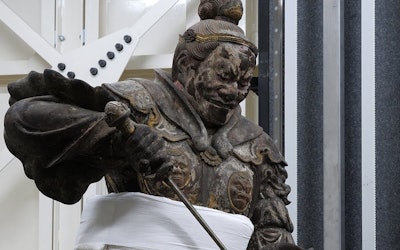
A CT Scan of a Buddhist Statue Reveals It to Be the Work of Genius Buddhist Sculptor Unkei?! This Massive Work of Art Has the Potential to Change What We Know About History!
History Art & Architecture- 277 plays
- YouTube
CT Scanning Research of the Four Heavenly Kings Statues of Nan'en-do at Kofukuji Temple in Nara! This video, titled "Unkei’s ‘mark’ found on Four Heavenly Kings standing statues," is about the Four Heavenly Kings statues at Nan'en-do in Nara Prefecture. It was published by "Asahi Shimbun." In 2017, the Tokyo National Museum conducted CT scans on the Buddhist statues of Kofukuji Temple in Nara Prefecture (奈良県, Nara-ken) to coincide with a special exhibit called "Unkei—The Great Master of Buddhist Sculpture." It opened up the possibility that the creator of the Mujaku and Seshin standing statues (無著世親菩薩立像, Mujaku Seshin Bosatsu Ryuzo), known as the most highly acclaimed Japanese sculptures, was none other than genius Buddhist sculptor Unkei. Presently in Japan, it is said that there are 31 other statues created by Unkei, but there is a likelihood that the number will rise as surveys continue. The CT Scan Research of the Four Heavenly Kings Statues Source :YouTube screenshot According to the video, by CT scanning the Four Heavenly Kings statues of Nan'en-do, and the Mujaku and Seshin standing statues of the North Round Hall (北円堂, Hokuendo), it was discovered that wooden parts containing tree cores had been combined to make both groups of statues. It is therefore said that the Four Heavenly Kings statues at Kofukuji Temple were created by Unkei. The commonality in technique used in the Mujaku and Seshin statues is an important factor to back the claim that the creator of both groups of statues is Unkei. In the video, the statue, over 2 meters tall, is neatly wrapped, and from 0:49 in the video, the x-ray CT scanning begins. From 0:10 in the video, Ryusuke Asami, section chief of the planning division at the Tokyo National Museum, says in interview, "the Four Heavenly Kings statues have never been photographed using x-rays before and the structures of the insides of the statues has also not been understood." What are the Four Heavenly Kings? Source :YouTube screenshot The Four Heavenly Kings are the four gods of Buddhism that protect the four directions and consist of the Jikokuten statue (持国天像, Jikokuten-zo) of the east, the Zojoten statue (増長天像, Zojoten-zo) of the south, the Komokuten (広目天像, Komokuten-zo) statue of the west, and the Tamokuten statue (多聞天像, Tamonten-zo) of the North. The Four Heavenly Kings statues at Kofukuji Temple were thought to be the works of Unkei’s father, Kokei, but from this research and researches on their styles, it has become increasingly believable that these were created by the hands of Unkei himself. The National Treasures and Important Cultural Properties of Kofukuji Temple Photo:Nara Prefecture・Kofukuji Kofukuji Temple, located in Nara Prefecture, consists of historical buildings, such as the East Golden Hall (東金堂, Tokondo), the West Golden Hall (西金堂, Saikondo), the North Round Hall, and the South Round Hall (Nan'en-do). The wooden statues of the Four Heavenly Kings at Kofukuji were moved from the Old Golden Hall (旧金堂, Kyukondo) to the South Round Hall replacing the Four Heavenly Kings statues in the South Round Hall, which are introduced in the video. Other than these, there are many temple treasures at Kofukuji Temple which were created during the Heian period (794-1185) and the Kamakura period (1185-1333), including the Asura statue, the wooden Medicine King (Bhaishajyaraja) and Medicine Superior standing statues (薬王菩薩・薬上菩薩立像, Mokuzo Yakuobosatsu・Yakujobosatsu Ryuzo), the bronze Medicine Master sitting statue (薬師如来坐像, Yakushinyorai Zazo), Ryowakiji statue, the wooden Manjushri standing statue (文殊菩薩立像, Monjubosatsu Ryuzo), the wooden Vimalakirti sitting statue (維摩居士坐像, Yuimakoji Zazo), the wooden Twelve Heavenly Generals standing statues (十二神将立像, Junishinsho Ryuzo), and the bronze Buddha head. Summary of the Four Heavenly Kings of Kofukuji Source :YouTube screenshot This article introduced the massive discovery of the Four Heavenly Kings of Kofukuji possibly being created by the genius Buddhist sculptor, Unkei. The research by the Tokyo National Museum may lead to an important discovery that unravels the mysteries of history. Nara Prefecture has flourished for more than a thousand years, back when it was called Heijokyo (平城京, Heijo-kyo), and it still has many sightseeing locations, such as Todaiji Temple, Kasuga Shrine (春日大社, Kasuga-taisha), Yakushiji Temple, Taima Temple (当麻寺, Taimadera), and more. If you’re interested in Buddhist statues or Japanese history in general, we urge you to visit! 【Official Website】The Head Temple of the Hosso School (法相宗, Hosso-shu) Kofukuji Temple https://www.kohfukuji.com/english/ -
 Video article 5:00
What Does the Future Have in Store for Us? The State-Of-The-Art Technology in the Super Smart Society, "society5.0", Proposed by the Government!
Life & Business- 251 plays
- YouTube
Check out the Introduction Video of the Super Smart Society "society5.0" "Super Smart Society: Opening the Future Society 5.0(超スマート社会 未来を開くSociety 5.0)" produced by jstsciencechannel is a video about "Society5.0". Society5.0 is a super smart society based on the Science and Technology Master Plan recommended by the Ministry of Education, Culture, Sports, Science and Technology and Japan Business Federation. The government has stated that it will begin efforts to realize a super-smart society led by science, and innovation, following the hunting, agricultural, industrial, and information society. Ultra-Smart Society "society5.0" Initiative 1: Smart Factories Source :YouTube screenshot The Internet connection of things, which is used in all aspects of industry and life, is called IoT. It is expected that new values will be created one after another by integrating the real world and cyberspace through communication. For example, in the industrial field, smart production systems (smart factories) that connect artificial intelligence sensors and big data on production lines, like the 4th Industrial Revolution recommended in Germany, are attracting attention. This can be seen at 0:30 in the video. Ultra-Smart Society "society5.0" Initiative 2: Ultra-Compact Mobility Source :YouTube screenshot Intelligent transportation system is one of the initiatives of Society5.0. At Asuka Village in Nara Prefecture, they are conducting a demonstration test of the “MICHIMO” rental service of “micro-miniature mobility” for tourists. You can watch a video of a commentary on the ruins of the Ishibutai Tomb being checked on a terminal mounted on an electric vehicle. In addition, the management of electric vehicles can be easily performed with the “Charging/Authentication System”. In addition, experiments on the uniform automatic driving of buses and trucks are already underway. The aim is to improve the efficiency of road transport and reduce traffic accidents. This can be seen from 1:18 in the video. Ultra-Smart Society "society5.0" Initiative 3: Community-Based Comprehensive Care System Source :YouTube screenshot The super-smart society "Society5.0" is also useful for medical care and health management. Innovative systems that can be used in medicine are being developed one after another, such as a cuffless blood pressure measurement using a chair, and a system that can take electrocardiogram measurements while sleeping with an electrode device sewn in pajamas or a bed cover. Data can be sent in real time to physicians at remote locations, and while currently patients currently need to visit hospitals for a checkup, with this system, they are protected by the network and can be informed that something is wrong before they even know it. This can be seen from 2:49 in the video. Summary of "society5.0" Source :YouTube screenshot In addition to being introduced in the video, Society 5.0 is expected to be used in artificial energy and for mass data in the fields of energy and disaster prevention, as well as in education and corporate sites. Through the efforts of the Cabinet Office and the Japan Business Federation, “Society5.0” will lead to new that will continue to be developed society. Are you looking forward to seeing what kind of technology will be created in the coming years? -
Video article 4:04
Chasen: Introducing the Characteristics and History of the Takayama Tea Whisk – A 500-Year-Old Utensil Essential for Traditional Japanese Tea Ceremony
Traditional Crafts History- 399 plays
- YouTube
Takayama Tea Whisks This video was made by Japanese Traditional Crafts Aoyama Square, a shop dedicated to Japanese traditional crafts, to introduce the Takayama Tea Whisk. Photo:Chasen (Tea Whisk) In the unique culture of Japanese tea ceremony, tea whisks are used for making matcha tea. Takayama Tea Whisks are traditional instruments made of bamboo and individually hand-crafted by artisans. In this article we'll introduce the charms and manufacturing process of Takayama Tea Whisks. Be sure to follow along with the video. Takayama Tea Whisks and Traditional Japanese Tea Ceremony Source :YouTube screenshot Japan has many traditional crafts with a long history. There is a wide variety of crafts including lacquerwares, ceramic wares, Buddhist altars, textiles, bamboo works, woodworks, Japanese paper, and many more. Tea ceremony utensils are traditional crafts that also have high cultural value as well. The tradition of tea drinking is said to have already started in the Heian period (794-1185 AD) in Japan. During the Kamakura period (1185 – 1333 AD), monk Eisai brought tea ceremony to Japan. As one of the most expensive tea whisks used for tea ceremony, the traditional Takayama Tea Whisk is made in Takayama in Ikoma City, Nara. The History and Cultural Value of Takayama Tea Whisks The production of Takayama Tea Whisks started around the middle of the Muromachi period (1336 – 1573 AD). The tea whisk was requested by Juko Murata, who started the tradition of Wabicha (a style of tea ceremony). Takayama Tamibe-no Jounyudo Souzetsu, the lord of Takayama’s son, accepted the request and made a special tea whisk for Murata. The tea whisk was presented to Emperor Gotsuchimikado and cherished by him. After the Edo period, the art of making Takayama Tea whisks had been handed down from artisans to only one of their children as a secret technique. In recent years however, the craftmanship has been passed down to 16 apprentices. The craft has been passed on as a handicraft of artisans in Takayama, Nara as well. The Characteristics and Manufacturing Process of Takayama Tea Whisks Source :YouTube screenshot Takayama Tea Whisks are made with many types of bamboo such as Henon bamboo, black bamboo and soot bamboo which is smoked in a hearth for many years. The edge of a bamboo pole is cracked into pieces, shaved thin, curled and fixed, then wrapped together to form a bamboo whisk. The painstakingly crafted Takayama Tea Whisks are truly works of art. Take a look at 0:29 in the video as it introduces the manufacturing process of Takayama Tea Whisks in detail. Summary of Takayama Tea Whisks The tradition of Japanese tea ceremony is also very popular outside Japan as it shows the Japanese spirit of Wabisabi. You can see that each tool made in the workshop is also a very profound traditional craft. We hope after reading this article and watching the video that we've sparked your interest in Takayama Tea Whisks. The maker of the video, Japan Traditional Crafts Aoyama Square, sells a variety of products including Takayama Tea Whisks. If you want to experience traditional Japanese culture or tea ceremony culture, we highly recommend that you purchase a traditional Takayama Tea Whisk. 【Official Website】Japan Traditional Crafts Aoyama Square https://kougeihin.jp/en/ -
Video article 19:48
Takoyaki, Sweets, High-Speed Mochi Making... A Visual and Auditory Feast for the Eyes and Ears! Enjoy the Cooking Process of Japan's World-Class Cuisine!
Food & Drink- 64 plays
- YouTube
Takoyaki, Sweets, High-Speed Rice Cake Making... Check Out the Amazing Artisanship in the Video! This video is a collection of artisanship from a variety of restaurants. Watching such skilled chefs creating amazing cuisine is something you never get tired of. You can watch the different shops using the timestamps below. Tsukiji - Gindaco: 0:08 Kyoto - Kyogoku Kaneyo: 3:50 Nara - Nakatanidou: 6:52 Osaka - Rikuro: 8:34 Kyoto - Tsurumusha: 11:22 Kyoto - Caffè Latte: 14:28 Kyoto - Gomaya Crepe-Do17:45 Unfortunately, Gomaya Crepe-do closed in 2019, but if you're in the Kansai region, be sure to stop by their shop there as well. 【Official Homepage】Tsukiji Gindaco Official Site https://www.gindaco.com/ 【Official Homepage】The Finest Eel in Japan, Kyogoku Kaneyo https://www.kyogokukaneyo.co.jp/ 【Official Homepage】Nakatanidou http://www.nakatanidou.jp/english/ 【Official Homepage】Osaka Confectioneries "Freshly Baked Cheesecakes," Rikuro Ojisan http://www.rikuro.co.jp/en/ 【Official Homepage】Ramen Tsurumusha https://www.tsurumusya.com/ 【Official Homepage】Caffè Latte http://caffe-llatte.com/index_e.php